 PoreWise
Aveeno · Creams
Daily Moisturizing Face Cream for Dry Skin with Oat
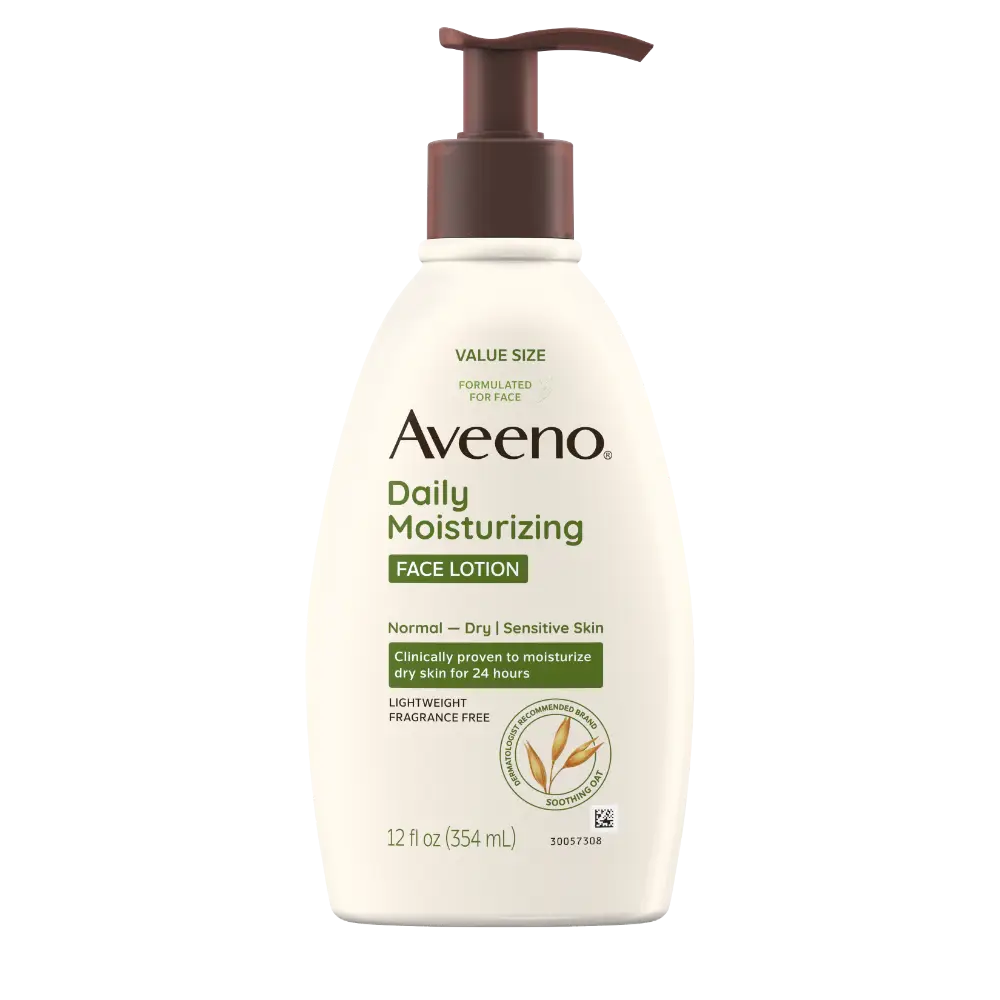
Product
- Brand:
- Aveeno
- Product type:
- Creams
- Last checked:
- 2026-10-30
- Formula version:
- Pack label · 2026-10-30
- Fragrance & alcohol:
- Fragrance-free · Alcohol-free
17 ingredients on this list · WATER at number 1 · GLYCERIN at number 2 · Dicaprylyl Ether at number 3
Product description
The cream version of the daily moisturizing face product for dry skin, built on the same oat-based formula.
Full ingredient list
Kept exactly as the source printed it, including spelling in the original.
- 1 WATER
- 2 GLYCERIN
- 3 DICAPRYLYL ETHER
- 4 AVENA SATIVA (OAT) KERNEL FLOUR
- 5 CAPRYLIC/CAPRIC TRIGLYCERIDE
- 6 CETYL ALCOHOL
- 7 CETEARYL ALCOHOL
- 8 PALMITIC ACID
- 9 STEARIC ACID
- 10 DIMETHICONE
- 11 PHENOXYETHANOL
- 12 CAPRYLYL GLYCOL
- 13 CARBOMER
- 14 CETEARETH-20
- 15 SODIUM HYDROXIDE
- 16 SODIUM CITRATE
- 17 CITRIC ACID
Original label text
Water, Glycerin, Dicaprylyl Ether, Avena Sativa (Oat) Kernel Flour, Caprylic/Capric Triglyceride, Cetyl Alcohol, Cetearyl Alcohol, Palmitic Acid, Stearic Acid, Dimethicone, Phenoxyethanol, Caprylyl Glycol, Carbomer, Ceteareth-20, Sodium Hydroxide, Sodium Citrate, Citric Acid
Ingredient analysis
GLYCERIN · Humectants · Dicaprylyl Ether · Emollients · DIMETHICONE · Occlusives
Emollients
7Fill the gaps between corneocytes to soften and smooth the surface.
Preservatives
2Inhibit microbial growth so the product stays safe to use.
Soothing agents
1Used to reduce the sensation of irritation or discomfort.
Texture agents
4Set the viscosity and feel of a formula.
Emulsifiers
3Keep oil and water mixed in a stable formula.
Evidence
- Skin effect Human trial Certainty: Moderate Primary source
In a randomized, double-blind, four-arm crossover study of 51 healthy volunteers with dry skin, an emollient containing glycerol and petrolatum raised corneometry-measured skin moisture significantly above its vehicle (P < 0.0001) over 12 hours. The authors attributed the hydration gain to the glycerol component and the lower water loss to the petrolatum component.
Who it applies to: Corneometry (skin moisture) and transepidermal water loss over 12 hours after one application.
Study limits: Measured on the forearms. The significant hydration result comes from the full emollient containing both glycerol and petrolatum.
- Skin effect Review article Certainty: Moderate Primary source
Topical glycerol improves stratum corneum hydration, barrier function and skin mechanical properties. The review also reports reduced irritation response and faster wound healing, and traces the effect to aquaporin-3 transport and to glycerol's own presence in the skin.
Who it applies to: Leave-on products. The review discusses both healthy skin and skin with dry or barrier-impaired conditions such as atopic dermatitis.
Study limits: A narrative review. It compiles mechanisms and results from other studies.
- Skin effect Official ingredient listing Certainty: High Public database
Glycerin is classified as a humectant in cosmetic ingredient databases: its role in a formula is to hold water.
Who it applies to: Cosmetic formulas generally. · Ingredient database · GLYCERIN
Study limits: Skin effect of to the stratum corneum comes from a separate review of the literature. · Ingredient database · GLYCERIN
- Pore clogging Animal study Certainty: Low Primary source
In the rabbit ear-canal assay, the nine materials graded positive were eight esters (isopropyl palmitate, isopropyl myristate, butyl stearate, isopropyl isostearate, decyl oleate, isostearyl neopentanoate, isocetyl stearate, myristyl myristate) and cocoa butter.
Who it applies to: Materials applied to the rabbit ear canal as raw ingredients.
Study limits: An animal assay. The rabbit ear canal reacts more readily than human skin. The abstract names the positive group.
- Irritation Review article Certainty: Low Primary source
The CIR expert panel's 1985 assessment of stearyl alcohol reports minimal to mild cutaneous irritation in rabbit tests, and a very low order of irritation and sensitization in clinical patch testing. It concluded that stearyl alcohol is safe as used in cosmetics.
Who it applies to: Stearyl alcohol, one of the two fatty alcohols that cetearyl alcohol is made of, at the use concentrations reported to the panel.
Study limits: It assesses stearyl alcohol. It was published in 1985 and relies largely on data submitted by the ingredient trade association. "Very low order" is the panel's wording.
- Legal limits Official legal text Certainty: High Primary source
US regulation lists dimethicone as a permitted active ingredient in over-the-counter skin protectant products, at 1 to 30 percent. That is a legal status in one market, and it puts dimethicone in the same list as petrolatum, glycerin and colloidal oatmeal.
Who it applies to: Products sold in the US that make a skin-protectant claim, with dimethicone between 1 and 30 percent.
Study limits: A monograph entry sets what may be sold and what may be claimed. · 1993 · Consumers of over-the-counter skin protectant products in the US.
- Legal limits Official legal text Certainty: High Primary source
The EU Scientific Committee on Consumer Safety concluded in 2016 that 2-phenoxyethanol is safe as a preservative at a maximum of 1.0%, which is the limit already set in Annex V/29 of the EU Cosmetics Regulation. It estimated a margin of safety of about 50 for children.
Who it applies to: Phenoxyethanol used as a preservative in cosmetic products, at or below 1.0%.
Study limits: The dossier behind the conclusion was submitted by Cosmetics Europe, the industry association, and the committee lowered the default toxicokinetic factor from 4.0 to 1.0 on its way to the 1.0% conclusion. The final opinion kept 1.0%.
Related skin concerns
Skin concerns with evidence for ingredients on this list.
Formula history
1 version of this formula on record.