 PoreWise
Paula's Choice · Exfoliants
SKIN PERFECTING 2% BHA Liquid Exfoliant
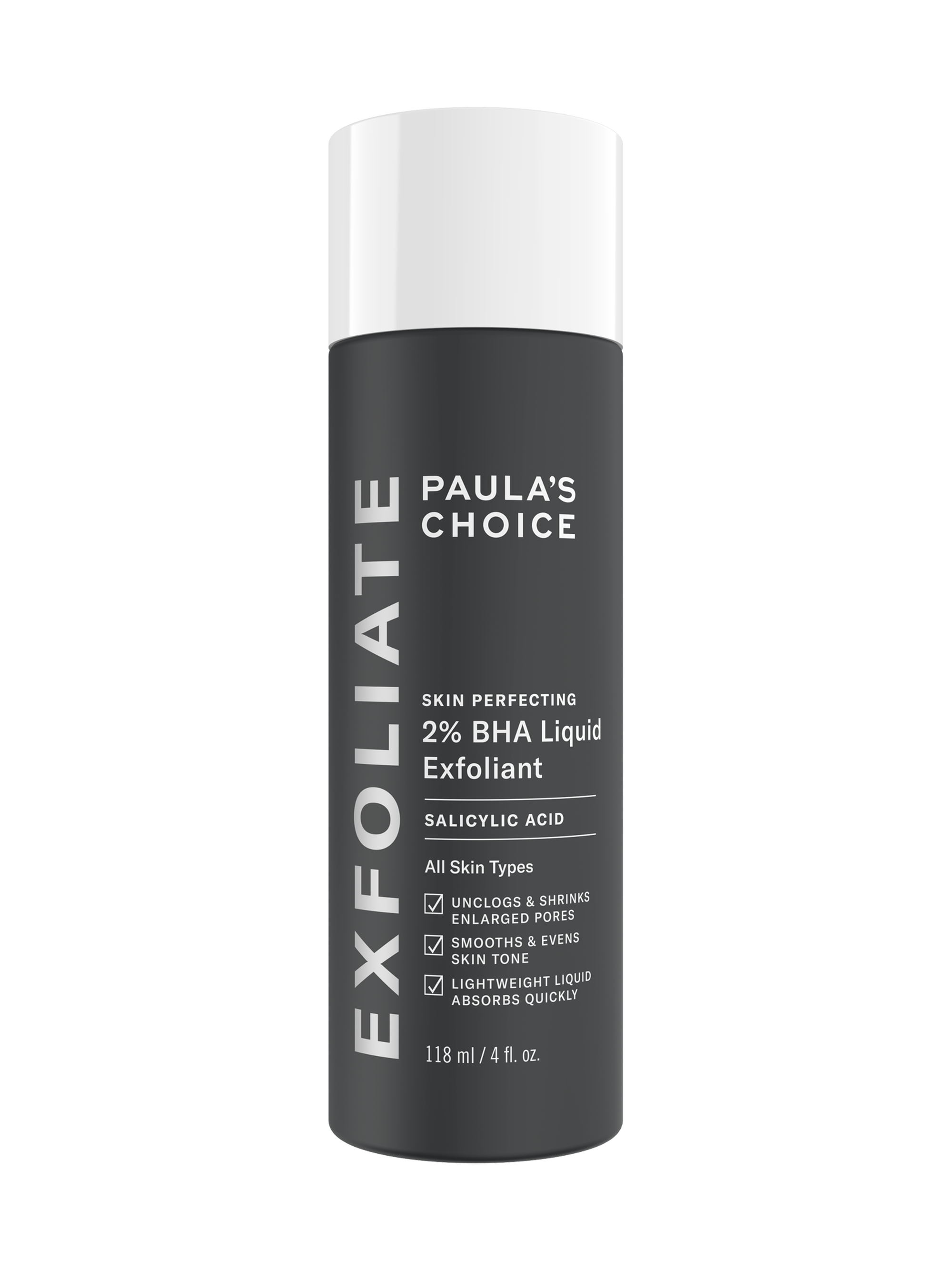
Product
- Brand:
- Paula's Choice
- Product type:
- Exfoliants
- Last checked:
- 2026-10-30
- Formula version:
- Pack label · 2026-10-30
- Fragrance & alcohol:
- Fragrance-free · Alcohol-free
8 ingredients on this list · WATER at number 1 · Methylpropanediol at number 2 · BUTYLENE GLYCOL at number 3
Product description
A leave-on liquid exfoliant with 2% salicylic acid (BHA). Marketed to unclog pores, smooth texture and control oil; pH around 3.2–3.8. Fragrance free, vegan.
Brand's own claims
- Unclogs pores and controls oil (brand claim).
- Clinically proven to boost cell turnover for smoother, clearer skin (brand claim).
The brand's own claims, quoted from its own material.
Full ingredient list
Kept exactly as the source printed it, including spelling in the original.
- 1 WATER
- 2 METHYLPROPANEDIOL
- 3 BUTYLENE GLYCOL
- 4 SALICYLIC ACID
- 5 POLYSORBATE 20
- 6 CAMELLIA OLEIFERA LEAF EXTRACT
- 7 SODIUM HYDROXIDE
- 8 TETRASODIUM EDTA
Original label text
Water, Methylpropanediol, Butylene Glycol, Salicylic Acid, Polysorbate 20, Camellia Oleifera, Sodium Hydroxide, Tetrasodium EDTA.
Ingredient analysis
SALICYLIC ACID · Actives · BUTYLENE GLYCOL · Humectants · POLYSORBATE 20 · Cleansing agents
Antioxidants
1Slow oxidation of the formula or of skin surface lipids.
Soothing agents
1Used to reduce the sensation of irritation or discomfort.
Evidence
- Skin effect Human trial Certainty: Moderate Primary source
In 83 adults with comedones, a serum containing salicylic acid and lipohydroxy acid significantly improved open comedones on the nose, closed comedones on the face, skin pore density, sebum secretion and skin hydration from baseline after 8 weeks; adding a mask improved closed comedones more than the serum alone (-6.56 vs -5.19, p = 0.022).
Who it applies to: Adults in Shanghai with comedones, PIE and PIH, using the serum for 8 weeks.
Study limits: Both groups used active products; improvements were reported against baseline and between the two active groups. Industry-funded. This is the trial found that counted open and closed comedones separately.
- Skin effect Clinical guideline Certainty: Moderate Primary source
The 2024 American Academy of Dermatology acne guideline lists topical salicylic acid as a conditional recommendation. Strong recommendations in the same guideline go to benzoyl peroxide, topical retinoids, topical antibiotics and oral doxycycline.
Who it applies to: Acne vulgaris in people aged nine and older, as covered by the guideline's scope.
- Skin effect Review article Certainty: Low Primary source
Against topical tretinoin, salicylic acid showed similar values in overall acne improvement (RR 1.00, 95% CI 0.92 to 1.09; one trial, 46 participants). The review graded the certainty of that finding as low.
Who it applies to: Topical salicylic acid for mild to moderate acne. Most participants in the review were 12 to 30 years old, and most studies ran longer than eight weeks.
Study limits: The review covers 49 trials with 3880 participants, salicylic acid appears in a small part of them: 41 to 86 participants per comparison. Every salicylic acid comparison was graded low or very low certainty.
- Skin effect Human trial Certainty: Very low Primary source
In a 21-day prospective study of 42 people with mild-to-moderate acne and oily or combination skin, a salicylic-acid-containing gel used twice daily was associated with a 23.65% fall in sebum, a 40.5% rise in skin hydration, a 49.26% fall in transepidermal water loss and a 23.81% improvement in acne grade (all P < 0.05 except IGA P < 0.001).
Who it applies to: Sebum, skin hydration, transepidermal water loss and acne grade over 21 days in people with oily or combination skin.
Study limits: One centre, 21 days, 37 of 42 participants were women, and the research group was affiliated with the product maker.
- Skin effect Brand claim Certainty: High Public database
Salicylic acid is a keratolytic: it loosens the bonds between dead skin cells so they shed.
Who it applies to: Acne and keratolysis, at the concentrations permitted for cosmetic use.
Study limits: Most evidence comes from leave-on acne treatments. A cleanser is on the skin for a minute. · Finding · SALICYLIC ACID
- Irritation Review article Certainty: Very low Primary source
Trials of topical salicylic acid for acne reported application-site reactions such as scaling and redness.
Who it applies to: Topical salicylic acid in acne trials, mainly leave-on use over eight weeks or longer.
Study limits: The review graded the salicylic acid adverse-event comparisons as very low certainty.
Related skin concerns
Skin concerns with evidence for ingredients on this list.
Formula history
1 version of this formula on record.