 PoreWise
Paula's Choice · Special treatments
CLINICAL 1% Retinol Treatment
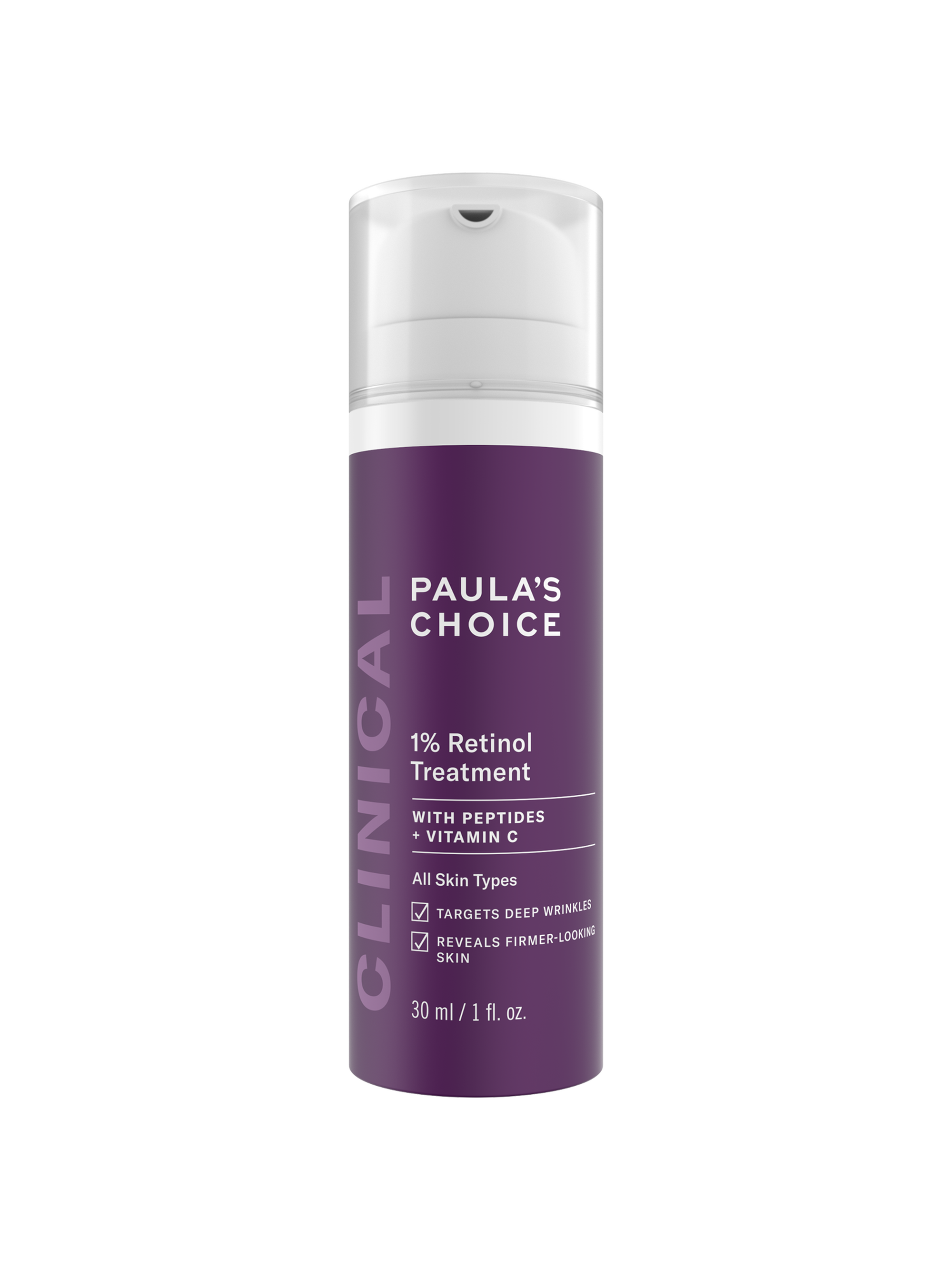
Product
- Brand:
- Paula's Choice
- Product type:
- Special treatments
- Last checked:
- 2026-10-30
- Formula version:
- Pack label · 2026-10-30
- Fragrance & alcohol:
- Fragrance-free · Alcohol-free
53 ingredients on this list · WATER at number 1 · DIMETHICONE at number 2 · GLYCERIN at number 3
Product description
A leave-on treatment with 1% retinol, alongside peptides, ceramides and a vitamin C derivative. The brand markets it for lines and loss of firmness.
Brand's own claims
- Softens lines and improves firmness (brand claim).
The brand's own claims, quoted from its own material.
Full ingredient list
Kept exactly as the source printed it, including spelling in the original.
- 1 WATER
- 2 DIMETHICONE
- 3 GLYCERIN
- 4 BUTYLENE GLYCOL
- 5 ISONONYL ISONONANOATE
- 6 CASTOR ISOSTEARATE SUCCINATE
- 7 GLYCERYL STEARATE
- 8 C12-15 ALKYL BENZOATE
- 9 DIMETHICONE CROSSPOLYMER
- 10 PEG-33
- 11 POLYSORBATE 20
- 12 BEHENYL ALCOHOL
- 13 PEG-100 STEARATE
- 14 PENTAERYTHRITYL TETRAISOSTEARATE
- 15 POLYMETHYLSILSESQUIOXANE
- 16 TETRAHEXYLDECYL ASCORBATE
- 17 RETINOL
- 18 CERAMIDE NG
- 19 PALMITOYL TETRAPEPTIDE-7
- 20 PALMITOYL HEXAPEPTIDE-12
- 21 SODIUM HYALURONATE
- 22 DIPOTASSIUM GLYCYRRHIZATE
- 23 GLYCYRRHIZA GLABRA (LICORICE) ROOT EXTRACT
- 24 AVENA SATIVA (OAT) KERNEL EXTRACT
- 25 ARCTIUM LAPPA ROOT EXTRACT
- 26 SALIX ALBA EXTRACT
- 27 GLYCINE SOJA (SOYBEAN) STEROLS
- 28 LECITHIN
- 29 ALLANTOIN
- 30 TOCOPHERYL ACETATE
- 31 HYDROLYZED SOY PROTEIN
- 32 SORBITAN LAURATE
- 33 ACETYL DIPEPTIDE-1 CETYL ESTER
- 34 DISODIUM EDTA
- 35 HYDROXYETHYLCELLULOSE
- 36 PALMITOYL TRIPEPTIDE-1
- 37 SODIUM HYDROXIDE
- 38 TRIBEHENIN
- 39 CAPRYLYL GLYCOL
- 40 ETHYLHEXYLGLYCERIN
- 41 PENTYLENE GLYCOL
- 42 PEG-75 SHEA BUTTER GLYCERIDES
- 43 PPG-12/SMDI COPOLYMER
- 44 PEG-10 PHYTOSTEROL
- 45 PEG-8 DIMETHICONE
- 46 PEG-14
- 47 MAGNESIUM ALUMINUM SILICATE
- 48 ARACHIDYL GLUCOSIDE
- 49 ARACHIDYL ALCOHOL
- 50 SCLEROTIUM GUM
- 51 CARBOMER
- 52 PHENOXYETHANOL
- 53 BENZOIC ACID
Original label text
Water, Dimethicone, Glycerin, Butylene Glycol, Isononyl Isononanoate, Castor Isostearate Succinate, Glyceryl Stearate, C12-15 Alkyl Benzoate, Dimethicone Crosspolymer, PEG-33, Polysorbate 20, Behenyl Alcohol, PEG-100 Stearate, Pentaerythrityl Tetraisostearate, Polymethylsilsesquioxane, Tetrahexyldecyl Ascorbate, Retinol, Ceramide NG, Palmitoyl Tetrapeptide-7, Palmitoyl Hexapeptide-12, Sodium Hyaluronate, Dipotassium Glycyrrhizate, Glycyrrhiza Glabra (Licorice) Root Extract, Avena Sativa (Oat) Kernel Extract, Arctium Lappa, Salix Alba Extract, Glycine Soja Sterols, Lecithin, Allantoin, Tocopheryl Acetate, Hydrolyzed Soy Protein, Sorbitan Laurate, Acetyl Dipeptide-1 Cetyl Ester, Disodium EDTA, Hydroxyethylcellulose, Palmitoyl Tripeptide-1, Sodium Hydroxide, Tribehenin, Caprylyl Glycol, Ethylhexylglycerin, Pentylene Glycol, PEG-75 Shea Butter Glycerides, PPG-12/SMDI Copolymer, PEG-10 Phytosterol, PEG-8 Dimethicone, PEG-14, Magnesium Aluminum Silicate, Arachidyl Glucoside, Arachidyl Alcohol, Sclerotium Gum, Carbomer, Phenoxyethanol, Benzoic Acid.
Ingredient analysis
TETRAHEXYLDECYL ASCORBATE · Actives · Ceramide NG · Barrier lipids · GLYCERIN · Humectants
Actives
6Ingredients added for a stated effect on the skin.
Barrier lipids
2Lipids that occur naturally in the skin barrier (ceramides, cholesterol, fatty acids).
Humectants
9Bind water and draw it into the upper layers of the skin.
Emollients
10Fill the gaps between corneocytes to soften and smooth the surface.
Cleansing agents
6Lift oil and dirt so they can be rinsed away with water.
Preservatives
4Inhibit microbial growth so the product stays safe to use.
Soothing agents
4Used to reduce the sensation of irritation or discomfort.
Texture agents
9Set the viscosity and feel of a formula.
Solvents
5Dissolve or carry other ingredients.
Emulsifiers
9Keep oil and water mixed in a stable formula.
Other
5Use on the ingredient list: see the product ingredient list.
Evidence
- Skin effect Human trial Certainty: High Primary source
Across six vehicle-controlled studies pooled together (237 on retinol, 234 on vehicle), 0.1% stabilised retinol produced greater improvements from baseline in all signs of photoaging than the vehicle from week 4 through week 12.
Who it applies to: Women around 47 years old with mild-to-moderate photoaging, applying the product for 12 weeks.
Study limits: Pooled analysis of six studies.
- Skin effect Human trial Certainty: Moderate Primary source
A 0.4% retinol lotion applied to the arm up to three times a week for 24 weeks reduced fine wrinkling significantly more than its vehicle in elderly subjects: score change −1.64 (95% CI −2.06 to −1.22) against −0.08 (−0.17 to 0.01) on a 0–9 severity scale.
Who it applies to: Elderly adults, arms.
Study limits: Thirty-six participants in two senior-care facilities, average age 87, an unusual population for cosmetic use. The glycosaminoglycan and procollagen measurements that suggest a mechanism came from subgroups of six and four participants, far too small to stand on their own.
- Skin effect Human trial Certainty: Moderate Primary source
In a split-face comparison, 0.075% retinol cream used once nightly for 26 weeks improved fine wrinkling in 27 of 54 participants (50%) against 13 (24%) on the vehicle side, and deep wrinkling in 15 (28%) against 1 (2%).
Who it applies to: Middle-aged Japanese women with mild photoaging, 0.075% retinol cream once nightly on the face for 26 weeks.
Study limits: Single centre, 57 enrolled and 54 evaluated, mild photoaging. The 0.04% arm ran for 13 weeks.
- Skin effect Human trial Certainty: Moderate Primary source
In a 12-week randomized, double-blind trial of 44 people, both 0.5% bakuchiol and 0.5% retinol significantly reduced wrinkle surface area and hyperpigmentation; bakuchiol caused less scaling and stinging.
Who it applies to: Adults with facial photoageing using bakuchiol twice daily or retinol once daily for 12 weeks.
Study limits: Small sample (44).
- Skin effect Human trial Certainty: Low Primary source
In a randomized, double-blind, placebo-controlled split-face trial, 24 people with mixed-type dark circles used a test product containing 3% vitamin C, 0.1% vitamin A and 0.5% vitamin E for eight weeks. Brightness (L*), melanin index and image-analysis lightness improved significantly on the treated side compared with the placebo side.
Who it applies to: Instrument-measured brightness, melanin index and skin thickness in mixed-type (pigment plus vascular) dark circles over eight weeks.
Study limits: Three actives were used together. 24 people took part, all with the mixed type of dark circles; a separate 100-person study was used first to choose which measurements to trust. The abstract reports instrument readings.
- Irritation Human trial Certainty: Low Primary source
Nightly 0.075% retinol caused enough irritation for 3 of 57 participants to withdraw from the study; at 0.04% over 13 weeks irritation was reported as minimal, with less improvement in fine wrinkling.
Who it applies to: Facial use once nightly in middle-aged Japanese women with mild photoaging, at 0.075% for 26 weeks and 0.04% for 13 weeks.
Study limits: Withdrawals were counted. Both findings come from the same single-centre study.
- Legal limits Official legal text Certainty: High Primary source
Retinol, retinyl acetate and retinyl palmitate are restricted under Annex III entry 376 of the EU Cosmetics Regulation: at most 0.05% retinol equivalent in body lotion and 0.3% in other leave-on and rinse-off products, with a mandatory label warning.
Who it applies to: Products placed on the EU market. Other jurisdictions set their own limits. · 2024
Study limits: This is a legal limit. · 2024
- Skin effect Human trial Certainty: Moderate Primary source
In a randomized, double-blind, four-arm crossover study of 51 healthy volunteers with dry skin, an emollient containing glycerol and petrolatum raised corneometry-measured skin moisture significantly above its vehicle (P < 0.0001) over 12 hours. The authors attributed the hydration gain to the glycerol component and the lower water loss to the petrolatum component.
Who it applies to: Corneometry (skin moisture) and transepidermal water loss over 12 hours after one application.
Study limits: Measured on the forearms. The significant hydration result comes from the full emollient containing both glycerol and petrolatum.
- Skin effect Review article Certainty: Moderate Primary source
Topical glycerol improves stratum corneum hydration, barrier function and skin mechanical properties. The review also reports reduced irritation response and faster wound healing, and traces the effect to aquaporin-3 transport and to glycerol's own presence in the skin.
Who it applies to: Leave-on products. The review discusses both healthy skin and skin with dry or barrier-impaired conditions such as atopic dermatitis.
Study limits: A narrative review. It compiles mechanisms and results from other studies.
- Skin effect Official ingredient listing Certainty: High Public database
Glycerin is classified as a humectant in cosmetic ingredient databases: its role in a formula is to hold water.
Who it applies to: Cosmetic formulas generally. · Ingredient database · GLYCERIN
Study limits: Skin effect of to the stratum corneum comes from a separate review of the literature. · Ingredient database · GLYCERIN
- Skin effect Human trial Certainty: Moderate Primary source
All five 0.1% hyaluronic acid creams tested, from 50 kDa to 2000 kDa, raised skin hydration and overall elasticity above the vehicle cream applied to the other eye at 60 days.
Who it applies to: 0.1% hyaluronic acid creams applied twice daily for 60 days to the eye area of women aged 30-60 with periocular wrinkles.
Study limits: Sixty days, and the vehicle sat on the fellow eye. Hydration and elasticity were read by instruments. The volunteers were women aged 30-60 with eye-area wrinkles.
- How deep it gets In vitro study Certainty: Moderate Primary source
Hyaluronic acid of 20-300 kDa crossed the stratum corneum in excised human skin, while hyaluronic acid of 1000-1400 kDa remained in the stratum corneum.
Who it applies to: Excised human skin with intact stratum corneum, measured by Raman micro-imaging after topical application.
Study limits: One laboratory's imaging study. Three molecular-weight grades were tested. "remains above" describes intact stratum corneum in this ex vivo setup.
- Skin effect Brand claim Certainty: Moderate Public database
Hyaluronic acid and its salt bind water at the skin surface, giving a plumper look immediately after application.
Who it applies to: Leave-on hydrating products.
Study limits: The effect is largely surface and temporary. In dry air a humectant. · Finding · Sodium hyaluronate · Hydrolyzed hyaluronic acid
- Legal limits Official legal text Certainty: High Primary source
US regulation lists dimethicone as a permitted active ingredient in over-the-counter skin protectant products, at 1 to 30 percent. That is a legal status in one market, and it puts dimethicone in the same list as petrolatum, glycerin and colloidal oatmeal.
Who it applies to: Products sold in the US that make a skin-protectant claim, with dimethicone between 1 and 30 percent.
Study limits: A monograph entry sets what may be sold and what may be claimed. · 1993 · Consumers of over-the-counter skin protectant products in the US.
- Legal limits Official legal text Certainty: High Primary source
The EU Scientific Committee on Consumer Safety concluded in 2016 that 2-phenoxyethanol is safe as a preservative at a maximum of 1.0%, which is the limit already set in Annex V/29 of the EU Cosmetics Regulation. It estimated a margin of safety of about 50 for children.
Who it applies to: Phenoxyethanol used as a preservative in cosmetic products, at or below 1.0%.
Study limits: The dossier behind the conclusion was submitted by Cosmetics Europe, the industry association, and the committee lowered the default toxicokinetic factor from 4.0 to 1.0 on its way to the 1.0% conclusion. The final opinion kept 1.0%.
Related skin concerns
Skin concerns with evidence for ingredients on this list.
Formula history
1 version of this formula on record.
Related products
- Exfoliants
RESIST Daily Smoothing Treatment with 5% AHA
14 shared ingredients
- Creams
Revitalizing Supreme+ Youth Power Soft Creme
13 shared ingredients
- Serums
10% Niacinamide Booster
13 shared ingredients
- Creams
Rapid Wrinkle Repair Regenerating Cream (Retinol + Hyaluronic Acid)
12 shared ingredients