 PoreWise
Paula's Choice · Exfoliants
RESIST Daily Smoothing Treatment with 5% AHA
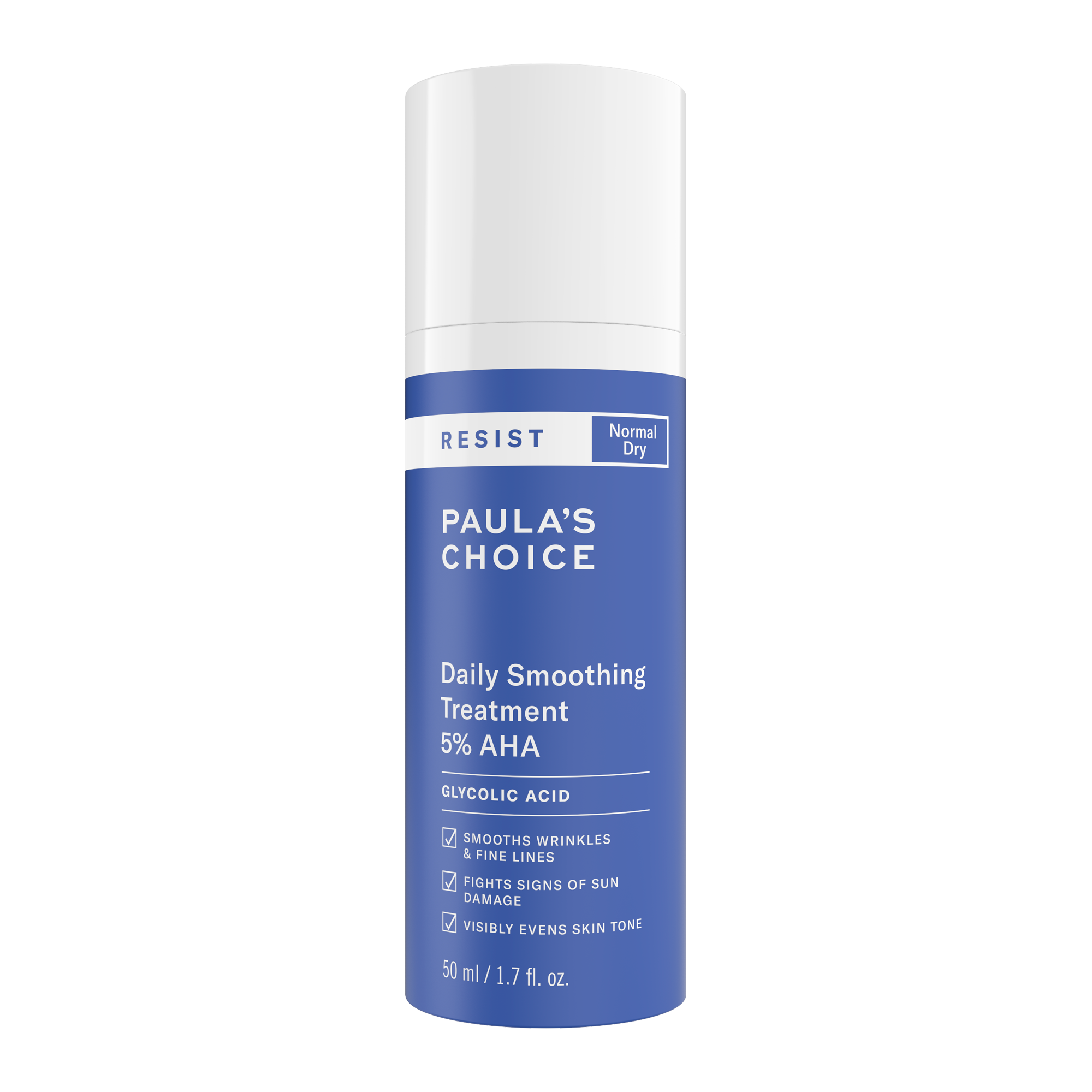
Product
- Brand:
- Paula's Choice
- Product type:
- Exfoliants
- Last checked:
- 2026-10-30
- Formula version:
- Pack label · 2026-10-30
- Fragrance & alcohol:
- Fragrance-free · Alcohol-free
36 ingredients on this list · WATER at number 1 · Glycolic acid at number 2 · CETYL ALCOHOL at number 3
Product description
A leave-on lotion exfoliant with 5% glycolic acid (AHA), plus salicylic acid and peptides. The brand markets it for normal to dry skin, for smoother and more even-toned skin.
Brand's own claims
- Gently exfoliates dead skin cells for smoother, radiant, even-toned skin (brand claim).
The brand's own claims, quoted from its own material.
Full ingredient list
Kept exactly as the source printed it, including spelling in the original.
- 1 WATER
- 2 GLYCOLIC ACID
- 3 CETYL ALCOHOL
- 4 BUTYLENE GLYCOL
- 5 POLYACRYLAMIDE
- 6 DIMETHICONE
- 7 PPG-14 BUTYL ETHER
- 8 PALMITOYL HEXAPEPTIDE-12
- 9 CERAMIDE NG
- 10 TETRAHYDRODIFERULOYLMETHANE
- 11 TETRAHYDRODEMETHOXYDIFERULOYLMETHANE
- 12 TETRAHYDROBISDEMETHOXYDIFERULOYLMETHANE
- 13 EPIGALLOCATECHIN GALLATE
- 14 SALICYLIC ACID
- 15 DISODIUM LAURIMINODIPROPIONATE TOCOPHERYL PHOSPHATES
- 16 PEG-10 PHYTOSTEROL
- 17 VANILLA PLANIFOLIA FRUIT EXTRACT
- 18 BISABOLOL
- 19 ALLANTOIN
- 20 CYCLOPENTASILOXANE
- 21 CYCLOHEXASILOXANE
- 22 DIMETHICONOL
- 23 TRIBEHENIN
- 24 C12-15 ALKYL BENZOATE
- 25 PEG-40 STEARATE
- 26 SORBITAN STEARATE
- 27 PVM/MA DECADIENE CROSSPOLYMER
- 28 DISODIUM EDTA
- 29 C13-14 ISOPARAFFIN
- 30 LAURETH-7
- 31 SODIUM HYDROXIDE
- 32 CAPRYLYL GLYCOL
- 33 CAPRYLIC/CAPRIC TRIGLYCERIDE
- 34 HEXYLENE GLYCOL
- 35 ETHYLHEXYLGLYCERIN
- 36 PHENOXYETHANOL
Original label text
Water, Glycolic Acid, Cetyl Alcohol, Butylene Glycol, Polyacrylamide, Dimethicone, PPG-14 Butyl Ether, Palmitoyl Hexapeptide-12, Ceramide NG, Tetrahydrodiferuloylmethane, Tetrahydrodemethoxydiferuloylmethane, Tetrahydrobisdemethoxydiferuloylmethane, Epigallocatechin Gallate, Salicylic Acid, Disodium Lauriminodipropionate Tocopheryl Phosphates, PEG-10 Phytosterol, Vanilla Planifolia Fruit Extract, Bisabolol, Allantoin, Cyclopentasiloxane, Cyclohexasiloxane, Dimethiconol, Tribehenin, C12-15 Alkyl Benzoate, PEG-40 Stearate, Sorbitan Stearate, PVM/MA Decadiene Crosspolymer, Disodium EDTA, C13-14 Isoparaffin, Laureth-7, Sodium Hydroxide, Caprylyl Glycol, Caprylic/Capric Triglyceride, Hexylene Glycol, Ethylhexylglycerin, Phenoxyethanol.
Ingredient analysis
Palmitoyl hexapeptide-12 · Actives · Ceramide NG · Barrier lipids · BUTYLENE GLYCOL · Humectants
Actives
2Ingredients added for a stated effect on the skin.
Barrier lipids
1Lipids that occur naturally in the skin barrier (ceramides, cholesterol, fatty acids).
Humectants
3Bind water and draw it into the upper layers of the skin.
Emollients
7Fill the gaps between corneocytes to soften and smooth the surface.
Cleansing agents
3Lift oil and dirt so they can be rinsed away with water.
Preservatives
4Inhibit microbial growth so the product stays safe to use.
Antioxidants
5Slow oxidation of the formula or of skin surface lipids.
Texture agents
5Set the viscosity and feel of a formula.
Solvents
5Dissolve or carry other ingredients.
Emulsifiers
5Keep oil and water mixed in a stable formula.
Other
6Use on the ingredient list: see the product ingredient list.
Evidence
- Skin effect Human trial Certainty: Moderate Primary source
In 83 adults with comedones, a serum containing salicylic acid and lipohydroxy acid significantly improved open comedones on the nose, closed comedones on the face, skin pore density, sebum secretion and skin hydration from baseline after 8 weeks; adding a mask improved closed comedones more than the serum alone (-6.56 vs -5.19, p = 0.022).
Who it applies to: Adults in Shanghai with comedones, PIE and PIH, using the serum for 8 weeks.
Study limits: Both groups used active products; improvements were reported against baseline and between the two active groups. Industry-funded. This is the trial found that counted open and closed comedones separately.
- Skin effect Clinical guideline Certainty: Moderate Primary source
The 2024 American Academy of Dermatology acne guideline lists topical salicylic acid as a conditional recommendation. Strong recommendations in the same guideline go to benzoyl peroxide, topical retinoids, topical antibiotics and oral doxycycline.
Who it applies to: Acne vulgaris in people aged nine and older, as covered by the guideline's scope.
- Skin effect Review article Certainty: Low Primary source
Against topical tretinoin, salicylic acid showed similar values in overall acne improvement (RR 1.00, 95% CI 0.92 to 1.09; one trial, 46 participants). The review graded the certainty of that finding as low.
Who it applies to: Topical salicylic acid for mild to moderate acne. Most participants in the review were 12 to 30 years old, and most studies ran longer than eight weeks.
Study limits: The review covers 49 trials with 3880 participants, salicylic acid appears in a small part of them: 41 to 86 participants per comparison. Every salicylic acid comparison was graded low or very low certainty.
- Skin effect Human trial Certainty: Very low Primary source
In a 21-day prospective study of 42 people with mild-to-moderate acne and oily or combination skin, a salicylic-acid-containing gel used twice daily was associated with a 23.65% fall in sebum, a 40.5% rise in skin hydration, a 49.26% fall in transepidermal water loss and a 23.81% improvement in acne grade (all P < 0.05 except IGA P < 0.001).
Who it applies to: Sebum, skin hydration, transepidermal water loss and acne grade over 21 days in people with oily or combination skin.
Study limits: One centre, 21 days, 37 of 42 participants were women, and the research group was affiliated with the product maker.
- Skin effect Brand claim Certainty: High Public database
Salicylic acid is a keratolytic: it loosens the bonds between dead skin cells so they shed.
Who it applies to: Acne and keratolysis, at the concentrations permitted for cosmetic use.
Study limits: Most evidence comes from leave-on acne treatments. A cleanser is on the skin for a minute. · Finding · SALICYLIC ACID
- Irritation Review article Certainty: Very low Primary source
Trials of topical salicylic acid for acne reported application-site reactions such as scaling and redness.
Who it applies to: Topical salicylic acid in acne trials, mainly leave-on use over eight weeks or longer.
Study limits: The review graded the salicylic acid adverse-event comparisons as very low certainty.
- Pore clogging Animal study Certainty: Low Primary source
In the rabbit ear-canal assay, the nine materials graded positive were eight esters (isopropyl palmitate, isopropyl myristate, butyl stearate, isopropyl isostearate, decyl oleate, isostearyl neopentanoate, isocetyl stearate, myristyl myristate) and cocoa butter.
Who it applies to: Materials applied to the rabbit ear canal as raw ingredients.
Study limits: An animal assay. The rabbit ear canal reacts more readily than human skin. The abstract names the positive group.
- Legal limits Official legal text Certainty: High Primary source
US regulation lists dimethicone as a permitted active ingredient in over-the-counter skin protectant products, at 1 to 30 percent. That is a legal status in one market, and it puts dimethicone in the same list as petrolatum, glycerin and colloidal oatmeal.
Who it applies to: Products sold in the US that make a skin-protectant claim, with dimethicone between 1 and 30 percent.
Study limits: A monograph entry sets what may be sold and what may be claimed. · 1993 · Consumers of over-the-counter skin protectant products in the US.
- Skin effect Human trial Certainty: Moderate Primary source
In a prospective, randomized, evaluator-blind, split-face trial of 20 patients with acne vulgaris, two 50% glycolic acid + 0.5% salicylic acid peels significantly reduced total lesion count (P<0.001) and produced fewer side effects than Jessner's solution.
Who it applies to: Patients with acne vulgaris receiving two 50% glycolic acid + 0.5% salicylic acid peels 2 weeks apart (one side vs Jessner's solution on the other).
Study limits: Small sample (20) and a combination peel (glycolic + salicylic acid); this is a procedural peel.
- Skin effect Human trial Certainty: Moderate Primary source
In a 2-week double-blind split-face study of 37 participants, a biphasic serum with 10% glycolic acid delivered 45.52% greater exfoliation (p<0.001) and improved skin brightness, texture and hydration versus the comparison side.
Who it applies to: Healthy participants using a 10% glycolic acid biphasic serum on one side of the face for 2 weeks.
Study limits: Short duration (2 weeks) and a single product formulation; the study measured exfoliation and cosmetic parameters.
- Skin effect Human trial Certainty: Low Primary source
In 23 women, a single application of a 4% alpha-hydroxy acid solution combined with negative-pressure physical action significantly reduced whitehead and blackhead counts at 1, 2 and 4 weeks, and reduced pore area and number at week 1, compared with AHA peeling alone.
Who it applies to: Healthy women receiving a single in-clinic application in a randomised split-face design, assessed at 1, 2 and 4 weeks.
Study limits: The intervention was a single in-clinic chemical peeling plus negative-pressure physical action.
- Legal limits Official legal text Certainty: High Primary source
The EU Scientific Committee on Consumer Safety concluded in 2016 that 2-phenoxyethanol is safe as a preservative at a maximum of 1.0%, which is the limit already set in Annex V/29 of the EU Cosmetics Regulation. It estimated a margin of safety of about 50 for children.
Who it applies to: Phenoxyethanol used as a preservative in cosmetic products, at or below 1.0%.
Study limits: The dossier behind the conclusion was submitted by Cosmetics Europe, the industry association, and the committee lowered the default toxicokinetic factor from 4.0 to 1.0 on its way to the 1.0% conclusion. The final opinion kept 1.0%.
Related skin concerns
Skin concerns with evidence for ingredients on this list.
Formula history
1 version of this formula on record.