 PoreWise
CeraVe · Serums
Hydrating Hyaluronic Acid Serum
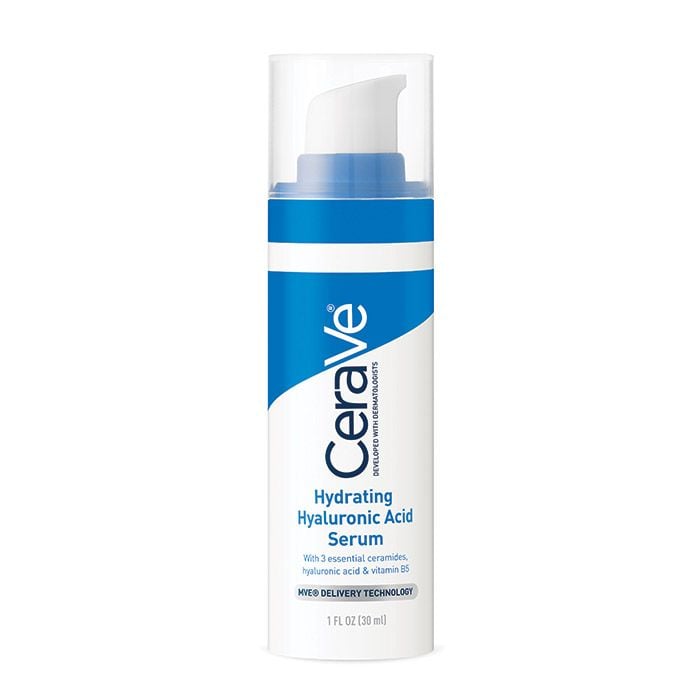
Product
- Brand:
- CeraVe
- Product type:
- Serums
- Last checked:
- 2026-10-12
- Formula version:
- Pack label · 2026-10-12
- Fragrance & alcohol:
- Fragrance-free · Alcohol-free
24 ingredients on this list · WATER at number 1 · GLYCERIN at number 2 · CETEARYL ETHYLHEXANOATE at number 3
Product description
A gel-cream serum with sodium hyaluronate, panthenol (vitamin B5) and three essential ceramides.
Brand's own claims
- Up to 24 hours of hydration (brand claim).
- 90% of consumers tested said skin felt intensely hydrated immediately after use (brand claim, consumer test).
The brand's own claims, quoted from its own material.
Full ingredient list
Kept exactly as the source printed it, including spelling in the original.
- 1 WATER
- 2 GLYCERIN
- 3 CETEARYL ETHYLHEXANOATE
- 4 DIMETHICONE
- 5 AMMONIUM POLYACRYLOYLDIMETHYL TAURATE
- 6 SODIUM HYALURONATE
- 7 PANTHENOL
- 8 CERAMIDE NP
- 9 CERAMIDE AP
- 10 CERAMIDE EOP
- 11 CARBOMER
- 12 CETEARYL ALCOHOL
- 13 BEHENTRIMONIUM METHOSULFATE
- 14 SODIUM HYDROXIDE
- 15 SODIUM LAUROYL LACTYLATE
- 16 CHOLESTEROL
- 17 PHENOXYETHANOL
- 18 DISODIUM EDTA
- 19 ISOPROPYL MYRISTATE
- 20 CAPRYLYL GLYCOL
- 21 CITRIC ACID
- 22 XANTHAN GUM
- 23 PHYTOSPHINGOSINE
- 24 ETHYLHEXYLGLYCERIN
Original label text
AQUA / WATER, GLYCERIN, CETEARYL ETHYLHEXANOATE, DIMETHICONE, AMMONIUM POLYACRYLOYLDIMETHYL TAURATE, SODIUM HYALURONATE, PANTHENOL, CERAMIDE NP, CERAMIDE AP, CERAMIDE EOP, CARBOMER, CETEARYL ALCOHOL, BEHENTRIMONIUM METHOSULFATE, SODIUM HYDROXIDE, SODIUM LAUROYL LACTYLATE, CHOLESTEROL, PHENOXYETHANOL, DISODIUM EDTA, ISOPROPYL MYRISTATE, CAPRYLYL GLYCOL, CITRIC ACID, XANTHAN GUM, PHYTOSPHINGOSINE, ETHYLHEXYLGLYCERIN
Ingredient analysis
CERAMIDE NP · Barrier lipids · GLYCERIN · Humectants · CETEARYL ETHYLHEXANOATE · Emollients
Barrier lipids
5Lipids that occur naturally in the skin barrier (ceramides, cholesterol, fatty acids).
Humectants
5Bind water and draw it into the upper layers of the skin.
Emollients
5Fill the gaps between corneocytes to soften and smooth the surface.
Cleansing agents
1Lift oil and dirt so they can be rinsed away with water.
Preservatives
3Inhibit microbial growth so the product stays safe to use.
Soothing agents
2Used to reduce the sensation of irritation or discomfort.
Texture agents
5Set the viscosity and feel of a formula.
Emulsifiers
3Keep oil and water mixed in a stable formula.
Evidence
- Skin effect Human trial Certainty: Moderate Primary source
In 88 women with sensitive skin, a face cream containing Centella asiatica leaf extract, ceramide NP and panthenol lowered the SS-10 symptom score by 66% at week 2 and 76% at week 4, with irritation, tautness, itching and redness all significantly reduced.
Who it applies to: Chinese women with sensitive skin applying the cream to the whole face, followed up at day 2, weeks 1, 2 and 4.
Study limits: Observational and self-controlled.
- Skin effect Human trial Certainty: Moderate Primary source
In a randomized, double-blind, vehicle-controlled split-body trial of 50 people with sensitive skin, an emollient containing Ceramide NP C15 significantly reduced transepidermal water loss in participants with an impaired skin barrier over 6 weeks.
Who it applies to: People with sensitive skin applying the emollient in a split-body design for 6 weeks; the barrier improvement was clearest in those whose barrier was already impaired.
Study limits: Exploratory; both the ceramide formulation and the vehicle improved subjective symptoms, and the significant TEWL reduction was seen specifically in the impaired-barrier subgroup.
- Skin effect Human trial Certainty: Moderate Primary source
In adults with mild-to-moderate xerosis (senile xerosis), a cream containing ceramides 1, 3, 6-II improved stratum corneum hydration, transepidermal water loss and skin pH more than a hydrophilic cream, measured at 24 hours and after 28 days of twice-daily use.
Who it applies to: Leave-on moisturizers for dry skin. The study enrolled adults with mild-to-moderate xerosis.
Study limits: Small single-site study (24 participants), split-site comparison on the shins, 28 days. It shows the tested formula outperformed a basic hydrophilic cream on measured skin parameters.
- Skin effect Human trial Certainty: Moderate Primary source
In 40 people with mild-to-moderate acne all using topical benzoyl peroxide plus adapalene, a moisturiser with ceramides and niacinamide significantly improved non-inflammatory, inflammatory and total acne lesions on that side of the face versus a hydrophilic cream after 8 weeks, and decreased cutaneous irritation.
Who it applies to: People on topical anti-acne medication who add a moisturiser alongside treatment, in a split-face, double-blind, randomized design for 8 weeks.
Study limits: All participants used prescription/OTC anti-acne drugs (5% benzoyl peroxide + 0.1% adapalene). TEWL, hydration, sebum, pH and other biophysical measures stayed close between the two creams. This is adjunctive care.
- Skin effect Brand claim Certainty: High Public database
Ceramides, cholesterol and fatty acids are the lipids that make up the skin barrier; formulations add them to replenish it.
Who it applies to: Barrier function generally; the ratio between the three lipid classes matters in the literature.
Study limits: Finding · CERAMIDE NP · Ceramide AP · Ceramide EOP
- Skin effect Human trial Certainty: Moderate Primary source
In a randomized, double-blind, four-arm crossover study of 51 healthy volunteers with dry skin, an emollient containing glycerol and petrolatum raised corneometry-measured skin moisture significantly above its vehicle (P < 0.0001) over 12 hours. The authors attributed the hydration gain to the glycerol component and the lower water loss to the petrolatum component.
Who it applies to: Corneometry (skin moisture) and transepidermal water loss over 12 hours after one application.
Study limits: Measured on the forearms. The significant hydration result comes from the full emollient containing both glycerol and petrolatum.
- Skin effect Review article Certainty: Moderate Primary source
Topical glycerol improves stratum corneum hydration, barrier function and skin mechanical properties. The review also reports reduced irritation response and faster wound healing, and traces the effect to aquaporin-3 transport and to glycerol's own presence in the skin.
Who it applies to: Leave-on products. The review discusses both healthy skin and skin with dry or barrier-impaired conditions such as atopic dermatitis.
Study limits: A narrative review. It compiles mechanisms and results from other studies.
- Skin effect Official ingredient listing Certainty: High Public database
Glycerin is classified as a humectant in cosmetic ingredient databases: its role in a formula is to hold water.
Who it applies to: Cosmetic formulas generally. · Ingredient database · GLYCERIN
Study limits: Skin effect of to the stratum corneum comes from a separate review of the literature. · Ingredient database · GLYCERIN
- Skin effect Human trial Certainty: Moderate Primary source
All five 0.1% hyaluronic acid creams tested, from 50 kDa to 2000 kDa, raised skin hydration and overall elasticity above the vehicle cream applied to the other eye at 60 days.
Who it applies to: 0.1% hyaluronic acid creams applied twice daily for 60 days to the eye area of women aged 30-60 with periocular wrinkles.
Study limits: Sixty days, and the vehicle sat on the fellow eye. Hydration and elasticity were read by instruments. The volunteers were women aged 30-60 with eye-area wrinkles.
- How deep it gets In vitro study Certainty: Moderate Primary source
Hyaluronic acid of 20-300 kDa crossed the stratum corneum in excised human skin, while hyaluronic acid of 1000-1400 kDa remained in the stratum corneum.
Who it applies to: Excised human skin with intact stratum corneum, measured by Raman micro-imaging after topical application.
Study limits: One laboratory's imaging study. Three molecular-weight grades were tested. "remains above" describes intact stratum corneum in this ex vivo setup.
- Skin effect Brand claim Certainty: Moderate Public database
Hyaluronic acid and its salt bind water at the skin surface, giving a plumper look immediately after application.
Who it applies to: Leave-on hydrating products.
Study limits: The effect is largely surface and temporary. In dry air a humectant. · Finding · Sodium hyaluronate · Hydrolyzed hyaluronic acid
- Skin effect Human trial Certainty: Moderate Primary source
In 38 children with atopic dermatitis, a cream containing linoleic acid, 5% dexpanthenol and ceramide improved SCORAD significantly more than a 5% urea cream after 4 weeks (P = 0.043); both groups improved from baseline.
Who it applies to: Children with mild-to-moderate atopic dermatitis applying the cream twice daily for 4 weeks in a randomised, double-blind, bilateral paired design.
Study limits: Both interventions were non-prescription moisturisers: this is emollient / basic skin care. Small sample (37 completed); stratum corneum hydration and time to remission stayed close between groups.
- Skin effect Human trial Certainty: Moderate Primary source
In 110 people with facial sensitive skin, a cream containing panthenol used twice daily for 28 days significantly increased stratum corneum moisture and reduced erythema index, redness (a* value) and transepidermal water loss.
Who it applies to: People with facial sensitive skin applying the cream twice daily for 28 days.
Study limits: Panthenol was combined with prebiotics and a probiotic lysate.
- Skin effect Human trial Certainty: Low Primary source
After facial non-ablative fractional laser treatment, a panthenol mask lowered the erythema and pigmentation indices on days 3, 7 and 14 against a saline dressing, raised stratum corneum moisture, and reduced transepidermal water loss over the same days. Sebum content was also higher in the mask group on days 7 and 14.
Who it applies to: Skin recovering from 1550 nm and 1927 nm non-ablative fractional laser on the face. Both groups received standard post-procedure care.
Study limits: The mask also contained madecassoside and bisabolol. It is one trial of 60 people, all recovering from the same procedure, and the published grant list includes L'Oreal Dermatological Beauty China (La Roche-Posay).
- Skin effect Human trial Certainty: Low Primary source
In a randomized, investigator-blind, split-face trial of 40 Asian acne patients, a moisturizer containing 4-t-butylcyclohexanol, licochalcone A, ceramide and panthenol improved facial hydration more than a traditional moisturizer (p=0.001) and produced lower dryness scores (p=0.021) over 4 weeks.
Who it applies to: Facial hydration and investigator-rated dryness over 4 weeks.
Study limits: All participants were on prescription acne therapy (including oral isotretinoin), so the dryness is drug-induced; both sides used a moisturizer, so this is a comparison between two moisturisers; acne lesion counts decreased equally on both sides.
- Sensitization Review article Certainty: Low Primary source
Panthenol is treated as non-allergenic, this review argues that frequent exposure, especially on damaged skin, can produce hypersensitivity to it. The likely route is a delayed (type IV) contact reaction; immediate and mixed reactions remain possible. Proposes patch testing with the patient's own product and with panthenol 5% in petrolatum.
Who it applies to: People who use panthenol products repeatedly, particularly those with atopic or damaged skin - the group the author says is most exposed.
Study limits: A single-author narrative review. The mechanism it proposes is stated as likely. Read it as a reason to keep panthenol on the list of possible allergens.
- Legal limits Official legal text Certainty: High Primary source
US regulation lists dimethicone as a permitted active ingredient in over-the-counter skin protectant products, at 1 to 30 percent. That is a legal status in one market, and it puts dimethicone in the same list as petrolatum, glycerin and colloidal oatmeal.
Who it applies to: Products sold in the US that make a skin-protectant claim, with dimethicone between 1 and 30 percent.
Study limits: A monograph entry sets what may be sold and what may be claimed. · 1993 · Consumers of over-the-counter skin protectant products in the US.
- Irritation Review article Certainty: Low Primary source
The CIR expert panel's 1985 assessment of stearyl alcohol reports minimal to mild cutaneous irritation in rabbit tests, and a very low order of irritation and sensitization in clinical patch testing. It concluded that stearyl alcohol is safe as used in cosmetics.
Who it applies to: Stearyl alcohol, one of the two fatty alcohols that cetearyl alcohol is made of, at the use concentrations reported to the panel.
Study limits: It assesses stearyl alcohol. It was published in 1985 and relies largely on data submitted by the ingredient trade association. "Very low order" is the panel's wording.
- Pore clogging Animal study Certainty: Low Primary source
In the rabbit ear-canal assay, the nine materials graded positive were eight esters (isopropyl palmitate, isopropyl myristate, butyl stearate, isopropyl isostearate, decyl oleate, isostearyl neopentanoate, isocetyl stearate, myristyl myristate) and cocoa butter.
Who it applies to: Materials applied to the rabbit ear canal as raw ingredients.
Study limits: An animal assay. The rabbit ear canal reacts more readily than human skin. The abstract names the positive group.
- Legal limits Official legal text Certainty: High Primary source
The EU Scientific Committee on Consumer Safety concluded in 2016 that 2-phenoxyethanol is safe as a preservative at a maximum of 1.0%, which is the limit already set in Annex V/29 of the EU Cosmetics Regulation. It estimated a margin of safety of about 50 for children.
Who it applies to: Phenoxyethanol used as a preservative in cosmetic products, at or below 1.0%.
Study limits: The dossier behind the conclusion was submitted by Cosmetics Europe, the industry association, and the committee lowered the default toxicokinetic factor from 4.0 to 1.0 on its way to the 1.0% conclusion. The final opinion kept 1.0%.
Related skin concerns
Skin concerns with evidence for ingredients on this list.
Formula history
1 version of this formula on record.