 PoreWise
The Ordinary · Serums
Salicylic Acid 2% Solution
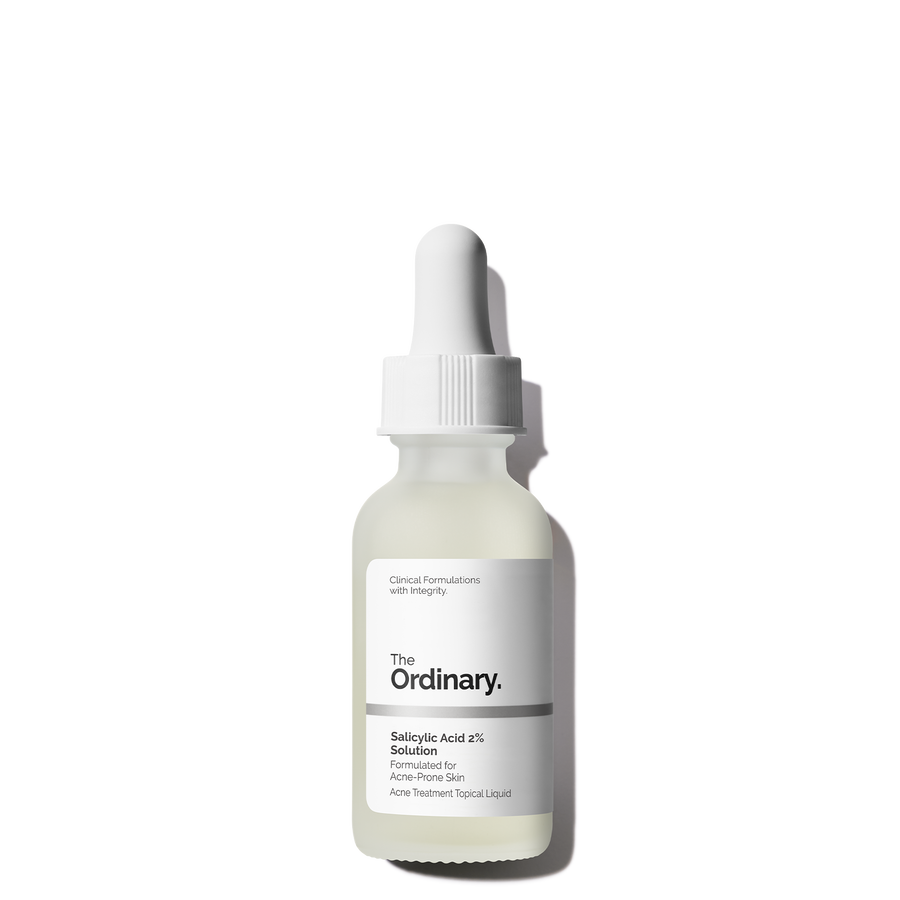
Product
- Brand:
- The Ordinary
- Product type:
- Serums
- Last checked:
- 2026-10-30
- Formula version:
- Pack label · 2026-10-30
- Fragrance & alcohol:
- Fragrance-free · Alcohol-free
12 ingredients on this list · SALICYLIC ACID at number 1 · WATER at number 2 · CHLORPHENESIN at number 3
Product description
A 2% salicylic acid solution marketed for acne-prone skin, in a water-based vehicle.
Full ingredient list
Kept exactly as the source printed it, including spelling in the original.
- 1 SALICYLIC ACID
- 2 WATER
- 3 CHLORPHENESIN
- 4 CITRIC ACID
- 5 GLYCERIN
- 6 ISOCETETH-20
- 7 PENTYLENE GLYCOL
- 8 PHENOXYETHANOL
- 9 SACCHARIDE ISOMERATE
- 10 SODIUM CITRATE
- 11 SODIUM HYDROXIDE
- 12 XANTHAN GUM
Original label text
Salicylic Acid, Water, Chlorphenesin, Citric Acid, Glycerin, Isoceteth-20, Pentylene Glycol, Phenoxyethanol, Saccharide Isomerate, Sodium Citrate, Sodium Hydroxide, Xanthan Gum
Ingredient analysis
SALICYLIC ACID · Actives · GLYCERIN · Humectants · ISOCETETH-20 · Cleansing agents
Humectants
3Bind water and draw it into the upper layers of the skin.
Preservatives
3Inhibit microbial growth so the product stays safe to use.
Evidence
- Skin effect Human trial Certainty: Moderate Primary source
In 83 adults with comedones, a serum containing salicylic acid and lipohydroxy acid significantly improved open comedones on the nose, closed comedones on the face, skin pore density, sebum secretion and skin hydration from baseline after 8 weeks; adding a mask improved closed comedones more than the serum alone (-6.56 vs -5.19, p = 0.022).
Who it applies to: Adults in Shanghai with comedones, PIE and PIH, using the serum for 8 weeks.
Study limits: Both groups used active products; improvements were reported against baseline and between the two active groups. Industry-funded. This is the trial found that counted open and closed comedones separately.
- Skin effect Clinical guideline Certainty: Moderate Primary source
The 2024 American Academy of Dermatology acne guideline lists topical salicylic acid as a conditional recommendation. Strong recommendations in the same guideline go to benzoyl peroxide, topical retinoids, topical antibiotics and oral doxycycline.
Who it applies to: Acne vulgaris in people aged nine and older, as covered by the guideline's scope.
- Skin effect Review article Certainty: Low Primary source
Against topical tretinoin, salicylic acid showed similar values in overall acne improvement (RR 1.00, 95% CI 0.92 to 1.09; one trial, 46 participants). The review graded the certainty of that finding as low.
Who it applies to: Topical salicylic acid for mild to moderate acne. Most participants in the review were 12 to 30 years old, and most studies ran longer than eight weeks.
Study limits: The review covers 49 trials with 3880 participants, salicylic acid appears in a small part of them: 41 to 86 participants per comparison. Every salicylic acid comparison was graded low or very low certainty.
- Skin effect Human trial Certainty: Very low Primary source
In a 21-day prospective study of 42 people with mild-to-moderate acne and oily or combination skin, a salicylic-acid-containing gel used twice daily was associated with a 23.65% fall in sebum, a 40.5% rise in skin hydration, a 49.26% fall in transepidermal water loss and a 23.81% improvement in acne grade (all P < 0.05 except IGA P < 0.001).
Who it applies to: Sebum, skin hydration, transepidermal water loss and acne grade over 21 days in people with oily or combination skin.
Study limits: One centre, 21 days, 37 of 42 participants were women, and the research group was affiliated with the product maker.
- Skin effect Brand claim Certainty: High Public database
Salicylic acid is a keratolytic: it loosens the bonds between dead skin cells so they shed.
Who it applies to: Acne and keratolysis, at the concentrations permitted for cosmetic use.
Study limits: Most evidence comes from leave-on acne treatments. A cleanser is on the skin for a minute. · Finding · SALICYLIC ACID
- Irritation Review article Certainty: Very low Primary source
Trials of topical salicylic acid for acne reported application-site reactions such as scaling and redness.
Who it applies to: Topical salicylic acid in acne trials, mainly leave-on use over eight weeks or longer.
Study limits: The review graded the salicylic acid adverse-event comparisons as very low certainty.
- Skin effect Human trial Certainty: Moderate Primary source
In a randomized, double-blind, four-arm crossover study of 51 healthy volunteers with dry skin, an emollient containing glycerol and petrolatum raised corneometry-measured skin moisture significantly above its vehicle (P < 0.0001) over 12 hours. The authors attributed the hydration gain to the glycerol component and the lower water loss to the petrolatum component.
Who it applies to: Corneometry (skin moisture) and transepidermal water loss over 12 hours after one application.
Study limits: Measured on the forearms. The significant hydration result comes from the full emollient containing both glycerol and petrolatum.
- Skin effect Review article Certainty: Moderate Primary source
Topical glycerol improves stratum corneum hydration, barrier function and skin mechanical properties. The review also reports reduced irritation response and faster wound healing, and traces the effect to aquaporin-3 transport and to glycerol's own presence in the skin.
Who it applies to: Leave-on products. The review discusses both healthy skin and skin with dry or barrier-impaired conditions such as atopic dermatitis.
Study limits: A narrative review. It compiles mechanisms and results from other studies.
- Skin effect Official ingredient listing Certainty: High Public database
Glycerin is classified as a humectant in cosmetic ingredient databases: its role in a formula is to hold water.
Who it applies to: Cosmetic formulas generally. · Ingredient database · GLYCERIN
Study limits: Skin effect of to the stratum corneum comes from a separate review of the literature. · Ingredient database · GLYCERIN
- Legal limits Official legal text Certainty: High Primary source
The EU Scientific Committee on Consumer Safety concluded in 2016 that 2-phenoxyethanol is safe as a preservative at a maximum of 1.0%, which is the limit already set in Annex V/29 of the EU Cosmetics Regulation. It estimated a margin of safety of about 50 for children.
Who it applies to: Phenoxyethanol used as a preservative in cosmetic products, at or below 1.0%.
Study limits: The dossier behind the conclusion was submitted by Cosmetics Europe, the industry association, and the committee lowered the default toxicokinetic factor from 4.0 to 1.0 on its way to the 1.0% conclusion. The final opinion kept 1.0%.
Related skin concerns
Skin concerns with evidence for ingredients on this list.
Formula history
1 version of this formula on record.