 PoreWise
La Roche-Posay · Sunscreens
Anthelios UVMune 400 Invisible Fluid SPF50+ (fragrance-free)
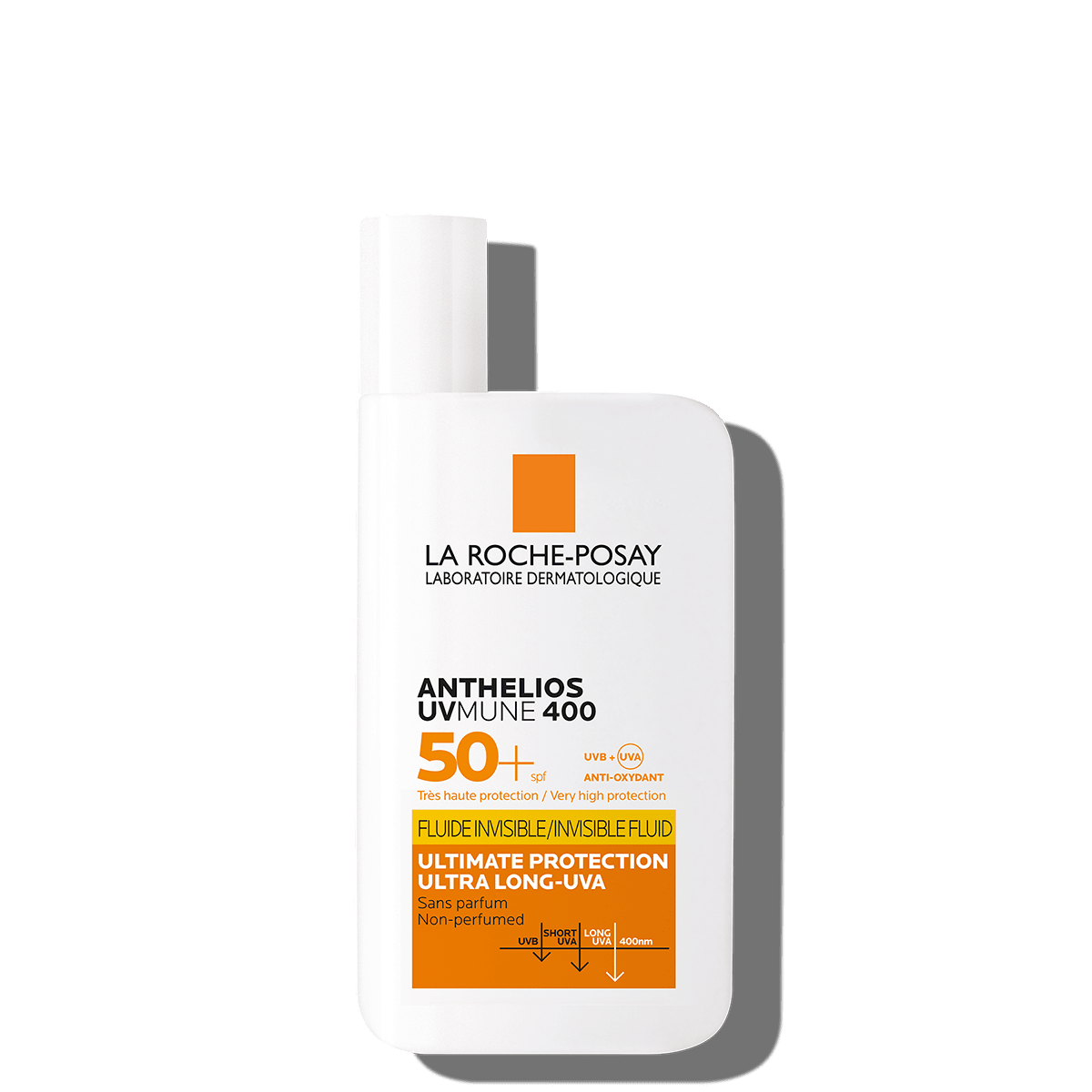
Product
- Brand:
- La Roche-Posay
- Product type:
- Sunscreens
- Source page:
- https://www.laroche-posay.hk/anthelios/anthelios-uvmune-400-invisible-fluid-spf50-without-perfume
- Last checked:
- 2026-10-30
- Formula version:
- Pack label · 2026-10-30 on the brand's Hong Kong product page
- Fragrance & alcohol:
- Fragrance-free · Contains alcohol (denatured)
26 ingredients on this list · WATER at number 1 · Denatured Alcohol at number 2 · TRIETHYL CITRATE at number 3
Product description
A fluid facial sunscreen built on eight organic filters: octisalate, bemotrizinol, ethylhexyl triazone, avobenzone, DHHB, drometrizole trisiloxane, Mexoryl SX and the long-UVA filter the brand markets as Mexoryl 400 (MCE). Alcohol denat. is second on the list.
Brand's own claims
The brand's own claims, quoted from its own material.
Full ingredient list
Kept exactly as the source printed it, including spelling in the original.
- 1 WATER
- 2 ALCOHOL DENAT.
- 3 TRIETHYL CITRATE
- 4 DIISOPROPYL SEBACATE
- 5 SILICA
- 6 OCTISALATE
- 7 BIS-ETHYLHEXYLOXYPHENOL METHOXYPHENYL TRIAZINE
- 8 ETHYLHEXYL TRIAZONE
- 9 BUTYL METHOXYDIBENZOYLMETHANE
- 10 GLYCERIN
- 11 PROPANEDIOL
- 12 C12-22 ALKYL ACRYLATE/HYDROXYETHYLACRYLATE COPOLYMER
- 13 SODIUM CITRATE
- 14 METHOXYPROPYLAMINO CYCLOHEXENYLIDENE ETHOXYETHYLCYANOACETATE
- 15 PERLITE
- 16 TOCOPHEROL
- 17 CAPRYLIC/CAPRIC TRIGLYCERIDE
- 18 ACRYLATES/C10-30 ALKYL ACRYLATE CROSSPOLYMER
- 19 CAPRYLYL GLYCOL
- 20 CITRIC ACID
- 21 DIETHYLAMINO HYDROXYBENZOYL HEXYL BENZOATE
- 22 DROMETRIZOLE TRISILOXANE
- 23 HYDROXYETHYLCELLULOSE
- 24 TEREPHTHALYLIDENE DICAMPHOR SULFONIC ACID
- 25 TRIETHANOLAMINE
- 26 TRISODIUM ETHYLENEDIAMINE DISUCCINATE
Original label text
AQUA / WATER / EAU ● ALCOHOL DENAT ● TRIETHYL CITRATE ● DIISOPROPYL SEBACATE ● SILICA ● ETHYLHEXYL SALICYLATE ● BIS-ETHYLHEXYLOXYPHENOL METHOXYPHENYL TRIAZINE ● ETHYLHEXYL TRIAZONE ● BUTYL METHOXYDIBENZOYLMETHANE ● GLYCERIN ● PROPANEDIOL ● C12-22 ALKYL ACRYLATE/HYDROXYETHYLACRYLATE COPOLYMER ● SODIUM CITRATE ● METHOXYPROPYLAMINO CYCLOHEXENYLIDENE ETHOXYETHYLCYANOACETATE ● PERLITE ● TOCOPHEROL ● CAPRYLIC/CAPRIC TRIGLYCERIDE ● ACRYLATES/C10-30 ALKYL ACRYLATE CROSSPOLYMER ● CAPRYLYL GLYCOL ● CITRIC ACID ● DIETHYLAMINO HYDROXYBENZOYL HEXYL BENZOATE ● DROMETRIZOLE TRISILOXANE ● HYDROXYETHYLCELLULOSE ● TEREPHTHALYLIDENE DICAMPHOR SULFONIC ACID ● TRIETHANOLAMINE ● TRISODIUM ETHYLENEDIAMINE DISUCCINATE
Ingredient analysis
GLYCERIN · Humectants · TRIETHYL CITRATE · Emollients · OCTISALATE · UV filters
Humectants
3Bind water and draw it into the upper layers of the skin.
Emollients
3Fill the gaps between corneocytes to soften and smooth the surface.
UV filters
8Absorb, reflect or scatter UV radiation before it reaches the skin.
Chelating agents
2Binds metal ions to keep the formula stable.
Texture agents
3Set the viscosity and feel of a formula.
Other
2Use on the ingredient list: see the product ingredient list.
Evidence
- Skin effect Human trial Certainty: Moderate Primary source
In a randomized, double-blind, four-arm crossover study of 51 healthy volunteers with dry skin, an emollient containing glycerol and petrolatum raised corneometry-measured skin moisture significantly above its vehicle (P < 0.0001) over 12 hours. The authors attributed the hydration gain to the glycerol component and the lower water loss to the petrolatum component.
Who it applies to: Corneometry (skin moisture) and transepidermal water loss over 12 hours after one application.
Study limits: Measured on the forearms. The significant hydration result comes from the full emollient containing both glycerol and petrolatum.
- Skin effect Review article Certainty: Moderate Primary source
Topical glycerol improves stratum corneum hydration, barrier function and skin mechanical properties. The review also reports reduced irritation response and faster wound healing, and traces the effect to aquaporin-3 transport and to glycerol's own presence in the skin.
Who it applies to: Leave-on products. The review discusses both healthy skin and skin with dry or barrier-impaired conditions such as atopic dermatitis.
Study limits: A narrative review. It compiles mechanisms and results from other studies.
- Skin effect Official ingredient listing Certainty: High Public database
Glycerin is classified as a humectant in cosmetic ingredient databases: its role in a formula is to hold water.
Who it applies to: Cosmetic formulas generally. · Ingredient database · GLYCERIN
Study limits: Skin effect of to the stratum corneum comes from a separate review of the literature. · Ingredient database · GLYCERIN
- Skin effect Human trial Certainty: High Primary source
In a randomized controlled community trial of 903 adults under 55, daily use of a broad-spectrum SPF 15+ sunscreen slowed skin aging over 4.5 years: the daily-sunscreen group showed 24% less photoaging than the discretionary-use group (relative odds 0.76, 95% CI 0.59 to 0.98). The trial measured the act of using a broad-spectrum sunscreen.
Who it applies to: Daily use of a broad-spectrum sunscreen in adults under 55 living in a high-UV climate.
Study limits: The trial assigned a broad-spectrum sunscreen. It ran in Australia at a high-UV latitude and stopped at 4.5 years, and the relative effect was modest (24%).
- Skin effect Review article Certainty: Moderate Primary source
A 2026 review of the 2015-2025 literature concluded that sun protection plays a central role in the prevention and treatment of pigmentation disorders including melasma and post-inflammatory hyperpigmentation, and that broad-spectrum sunscreens with visible-light protection may enhance protection against hyperpigmentation.
Who it applies to: People managing or preventing pigmentation disorders, particularly melasma and post-inflammatory hyperpigmentation; those with darker skin phototypes (IV-VI) where visible light can worsen hyperpigmentation.
Study limits: 2026 · People with melasma, post-inflammatory hyperpigmentation or vitiligo. · PMID 42793277
- Legal limits Official ingredient listing Certainty: High Primary source
UV filters are permitted up to the maximum concentrations set by each market's regulation.
Who it applies to: Products making a sunscreen claim. Limits differ between the EU, the US and China.
Study limits: Reapplication and the amount applied matter more than the label. · Ingredient database · AVOBENZONE · HOMOSALATE · OCTISALATE
- Skin effect Human trial Certainty: Moderate Primary source
In a split-face randomized controlled trial of 50 women, a serum with 20% vitamin C, vitamin E and raspberry leaf cell culture extract significantly improved skin radiance measured by Glossymeter GL200, along with skin colour and elasticity, over 2 months.
Who it applies to: Women aged 30-65 applying the serum to one side of the face for 2 months, with the untreated side as control.
Study limits: Split-face with an untreated.
- Skin effect Human trial Certainty: Low Primary source
In 31 women aged 43-65, a serum combining vitamins C and E with green tea polyphenols produced statistically significant improvements in all clinically graded parameters over 12 weeks, including enhanced skin smoothness and radiance, plus an ultrasound-measured increase in skin density.
Who it applies to: Women aged 43-65 with photoaged facial skin, applying the serum twice daily for 12 weeks.
Study limits: Radiance was a clinical grading parameter.
- Skin effect Human trial Certainty: Low Primary source
In a double-blind trial that split each scar into two halves. Or made worse, the cosmetic appearance.
Who it applies to: Scars after surgical removal of skin cancer, treated twice daily for four weeks with a petrolatum-based ointment.
Study limits: Fifteen people, one centre, published in 1999. Pigmentation, or the job vitamin E does inside a formula, where it slows oxidation of the oils.
- Sensitization Human trial Certainty: Low Primary source
In the same split-scar trial, 33% of the participants developed contact dermatitis to the vitamin E ointment.
Who it applies to: Vitamin E in a petrolatum-based ointment applied to healing surgical wounds, twice daily for four weeks.
Study limits: Small trial (15 people) with a single product.
Related skin concerns
Skin concerns with evidence for ingredients on this list.
Formula history
1 version of this formula on record.