 PoreWise
The Ordinary · Serums
Retinol 0.5% in Squalane
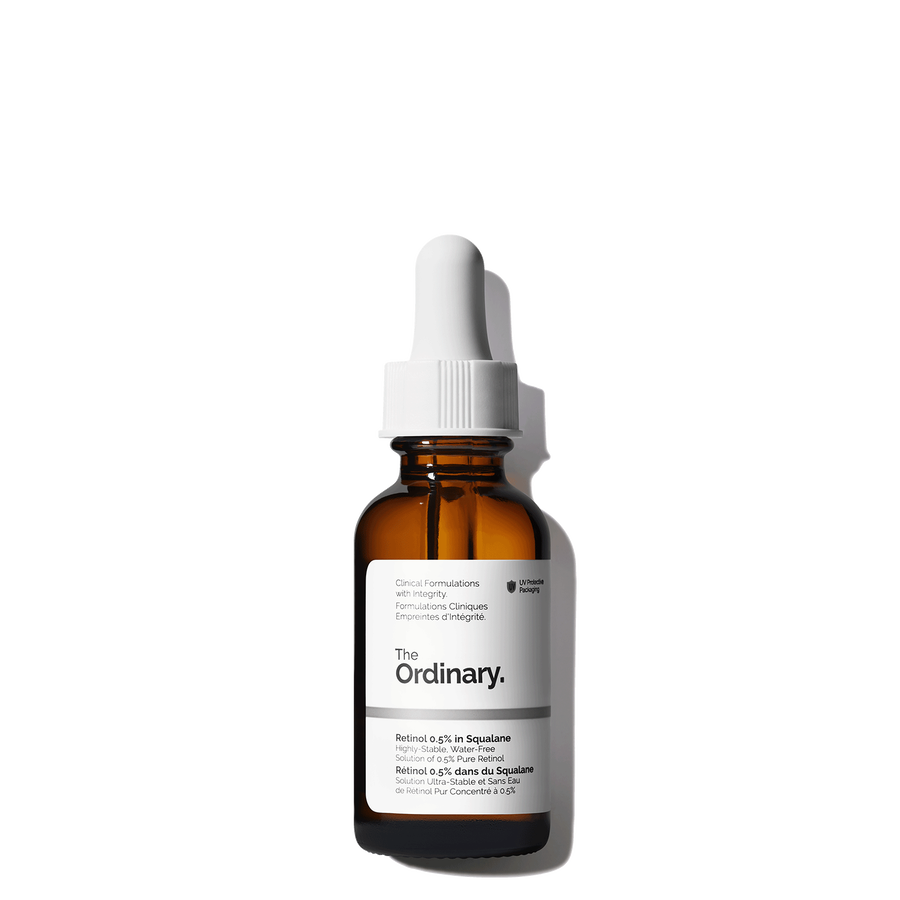
Product
- Brand:
- The Ordinary
- Product type:
- Serums
- Last checked:
- 2026-10-30
- Formula version:
- Pack label · 2026-10-30
- Fragrance & alcohol:
- Fragrance-free · Alcohol-free
8 ingredients on this list · SQUALANE at number 1 · CAPRYLIC/CAPRIC TRIGLYCERIDE at number 2 · Simmondsia Chinensis (Jojoba) Seed Oil at number 3
Product description
A 0.5% retinol serum suspended in squalane, an oil-based formula for gradual retinoid use.
Full ingredient list
Kept exactly as the source printed it, including spelling in the original.
- 1 SQUALANE
- 2 CAPRYLIC/CAPRIC TRIGLYCERIDE
- 3 SIMMONDSIA CHINENSIS (JOJOBA) SEED OIL
- 4 RETINOL
- 5 SOLANUM LYCOPERSICUM (TOMATO) FRUIT EXTRACT
- 6 ROSMARINUS OFFICINALIS (ROSEMARY) LEAF EXTRACT
- 7 HYDROXYMETHOXYPHENYL DECANONE
- 8 BHT
Original label text
Squalane, Caprylic/Capric Triglyceride, Simmondsia Chinensis (Jojoba) Seed Oil, Retinol, Solanum Lycopersicum (Tomato) Fruit Extract, Rosmarinus Officinalis (Rosemary) Leaf Extract, Hydroxymethoxyphenyl Decanone, BHT
Ingredient analysis
Retinol · Actives · SQUALANE · Emollients · SQUALANE · Occlusives
Emollients
3Fill the gaps between corneocytes to soften and smooth the surface.
Antioxidants
2Slow oxidation of the formula or of skin surface lipids.
Soothing agents
1Used to reduce the sensation of irritation or discomfort.
Other
2Use on the ingredient list: see the product ingredient list.
Evidence
- Skin effect Human trial Certainty: High Primary source
Across six vehicle-controlled studies pooled together (237 on retinol, 234 on vehicle), 0.1% stabilised retinol produced greater improvements from baseline in all signs of photoaging than the vehicle from week 4 through week 12.
Who it applies to: Women around 47 years old with mild-to-moderate photoaging, applying the product for 12 weeks.
Study limits: Pooled analysis of six studies.
- Skin effect Human trial Certainty: Moderate Primary source
A 0.4% retinol lotion applied to the arm up to three times a week for 24 weeks reduced fine wrinkling significantly more than its vehicle in elderly subjects: score change −1.64 (95% CI −2.06 to −1.22) against −0.08 (−0.17 to 0.01) on a 0–9 severity scale.
Who it applies to: Elderly adults, arms.
Study limits: Thirty-six participants in two senior-care facilities, average age 87, an unusual population for cosmetic use. The glycosaminoglycan and procollagen measurements that suggest a mechanism came from subgroups of six and four participants, far too small to stand on their own.
- Skin effect Human trial Certainty: Moderate Primary source
In a split-face comparison, 0.075% retinol cream used once nightly for 26 weeks improved fine wrinkling in 27 of 54 participants (50%) against 13 (24%) on the vehicle side, and deep wrinkling in 15 (28%) against 1 (2%).
Who it applies to: Middle-aged Japanese women with mild photoaging, 0.075% retinol cream once nightly on the face for 26 weeks.
Study limits: Single centre, 57 enrolled and 54 evaluated, mild photoaging. The 0.04% arm ran for 13 weeks.
- Skin effect Human trial Certainty: Moderate Primary source
In a 12-week randomized, double-blind trial of 44 people, both 0.5% bakuchiol and 0.5% retinol significantly reduced wrinkle surface area and hyperpigmentation; bakuchiol caused less scaling and stinging.
Who it applies to: Adults with facial photoageing using bakuchiol twice daily or retinol once daily for 12 weeks.
Study limits: Small sample (44).
- Skin effect Human trial Certainty: Low Primary source
In a randomized, double-blind, placebo-controlled split-face trial, 24 people with mixed-type dark circles used a test product containing 3% vitamin C, 0.1% vitamin A and 0.5% vitamin E for eight weeks. Brightness (L*), melanin index and image-analysis lightness improved significantly on the treated side compared with the placebo side.
Who it applies to: Instrument-measured brightness, melanin index and skin thickness in mixed-type (pigment plus vascular) dark circles over eight weeks.
Study limits: Three actives were used together. 24 people took part, all with the mixed type of dark circles; a separate 100-person study was used first to choose which measurements to trust. The abstract reports instrument readings.
- Irritation Human trial Certainty: Low Primary source
Nightly 0.075% retinol caused enough irritation for 3 of 57 participants to withdraw from the study; at 0.04% over 13 weeks irritation was reported as minimal, with less improvement in fine wrinkling.
Who it applies to: Facial use once nightly in middle-aged Japanese women with mild photoaging, at 0.075% for 26 weeks and 0.04% for 13 weeks.
Study limits: Withdrawals were counted. Both findings come from the same single-centre study.
- Legal limits Official legal text Certainty: High Primary source
Retinol, retinyl acetate and retinyl palmitate are restricted under Annex III entry 376 of the EU Cosmetics Regulation: at most 0.05% retinol equivalent in body lotion and 0.3% in other leave-on and rinse-off products, with a mandatory label warning.
Who it applies to: Products placed on the EU market. Other jurisdictions set their own limits. · 2024
Study limits: This is a legal limit. · 2024
Related skin concerns
Skin concerns with evidence for ingredients on this list.
Formula history
1 version of this formula on record.