 PoreWise
Anua · Serums
Niacinamide 10% + TXA 4% Serum
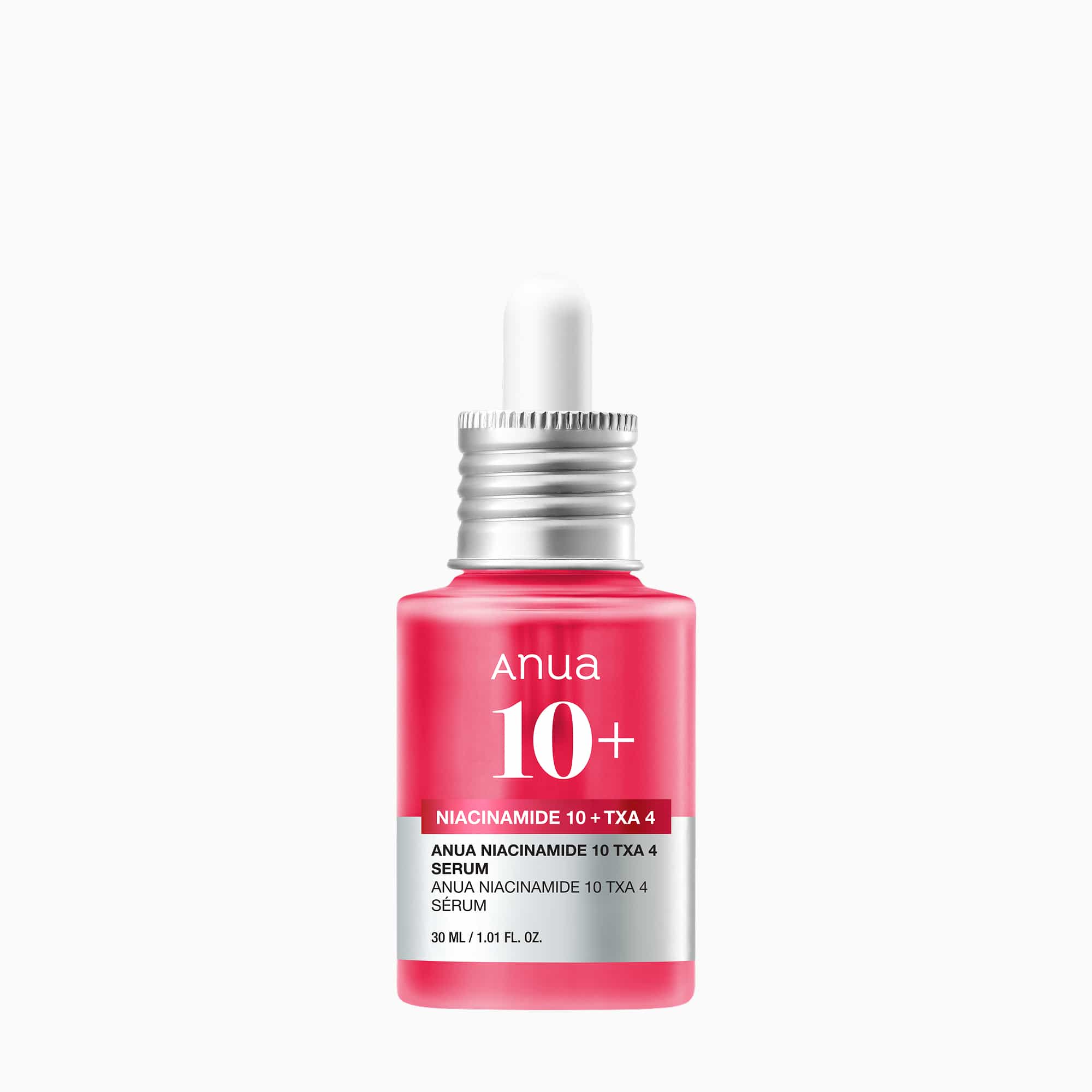
Product
- Brand:
- Anua
- Product type:
- Serums
- Last checked:
- 2026-10-30
- Formula version:
- Pack label · 2026-10-30
- Fragrance & alcohol:
- Fragrance-free · Alcohol-free
51 ingredients on this list · WATER at number 1 · GLYCERIN at number 2 · NIACINAMIDE at number 3
Product description
A serum listing 10% niacinamide and 4% tranexamic acid, with arbutin further down the list, marketed for dark spots and tone.
Full ingredient list
Kept exactly as the source printed it, including spelling in the original.
- 1 WATER
- 2 GLYCERIN
- 3 NIACINAMIDE
- 4 TRANEXAMIC ACID
- 5 BUTYLENE GLYCOL
- 6 DIETHOXYETHYL SUCCINATE
- 7 1,2-HEXANEDIOL
- 8 ARBUTIN
- 9 SODIUM HYALURONATE
- 10 ARBUTIN
- 11 COCCINIA INDICA FRUIT EXTRACT
- 12 ECLIPTA PROSTRATA EXTRACT
- 13 MACADAMIA INTEGRIFOLIA SEED OIL
- 14 OLEA EUROPAEA (OLIVE) FRUIT OIL
- 15 SIMMONDSIA CHINENSIS (JOJOBA) SEED OIL
- 16 VITIS VINIFERA (GRAPE) SEED OIL
- 17 THEOBROMA CACAO (COCOA) EXTRACT
- 18 HYDROLYZED HYALURONIC ACID
- 19 CHAMAECYPARIS OBTUSA LEAF EXTRACT
- 20 PRUNUS PERSICA (PEACH) FLOWER EXTRACT
- 21 CAMELLIA SINENSIS SEED OIL
- 22 YEAST FERMENT EXTRACT
- 23 CENTELLA ASIATICA EXTRACT
- 24 ARTEMISIA PRINCEPS LEAF EXTRACT
- 25 CANDIDA BOMBICOLA/GLUCOSE/METHYL RAPESEEDATE FERMENT
- 26 HYALURONIC ACID
- 27 PENTYLENE GLYCOL
- 28 BETAINE SALICYLATE
- 29 SUCROSE PALMITATE
- 30 HYDROGENATED LECITHIN
- 31 GELLAN GUM
- 32 SODIUM PHYTATE
- 33 CELLULOSE
- 34 CAPRYLIC/CAPRIC TRIGLYCERIDE
- 35 PANTHENOL
- 36 CYANOCOBALAMIN
- 37 POLYGLUTAMIC ACID
- 38 3-O-ETHYL ASCORBIC ACID
- 39 CERAMIDE NP
- 40 DEXTRIN
- 41 ASIATICOSIDE
- 42 MADECASSIC ACID
- 43 ASIATIC ACID
- 44 DIMETHYLSILANOL HYALURONATE
- 45 HYDROLYZED SODIUM HYALURONATE
- 46 POTASSIUM HYALURONATE
- 47 HYDROXYPROPYLTRIMONIUM HYALURONATE
- 48 SODIUM HYALURONATE CROSSPOLYMER
- 49 SODIUM HYALURONATE DIMETHYLSILANOL
- 50 SODIUM ACETYLATED HYALURONATE
- 51 XANTHAN GUM
Original label text
Water, Glycerin, Niacinamide, Tranexamic Acid, Butylene Glycol, Diethoxyethyl Succinate, 1,2-Hexanediol, Arbutin, Sodium Hyaluronate, Alpha-Arbutin, Coccinia Indica Fruit Extract, Eclipta Prostrata Extract, Macadamia Integrifolia Seed Oil, Olea Europaea (Olive) Fruit Oil, Simmondsia Chinensis (Jojoba) Seed Oil, Vitis Vinifera (Grape) Seed Oil, Theobroma Cacao (Cocoa) Extract, Hydrolyzed Hyaluronic Acid, Chamaecyparis Obtusa Leaf Extract, Prunus Persica (Peach) Flower Extract, Camellia Sinensis Seed Oil, Yeast Ferment Extract, Centella Asiatica Extract, Artemisia Princeps Leaf Extract, Candida Bombicola/Glucose/Methyl Rapeseedate Ferment, Hyaluronic Acid, Pentylene Glycol, Betaine Salicylate, Sucrose Palmitate, Hydrogenated Lecithin, Gellan Gum, Sodium Phytate, Cellulose, Caprylic/Capric Triglyceride, Panthenol, Cyanocobalamin, Polyglutamic Acid, 3-O-Ethyl Ascorbic Acid, Ceramide NP, Dextrin, Asiaticoside, Madecassic Acid, Asiatic Acid, Dimethylsilanol Hyaluronate, Hydrolyzed Sodium Hyaluronate, Potassium Hyaluronate, Hydroxypropyltrimonium Hyaluronate, Sodium Hyaluronate Crosspolymer, Sodium Hyaluronate Dimethylsilanol, Sodium Acetylated Hyaluronate, Xanthan Gum
Ingredient analysis
NIACINAMIDE · Actives · NIACINAMIDE · Barrier lipids · GLYCERIN · Humectants
Actives
5Ingredients added for a stated effect on the skin.
Barrier lipids
2Lipids that occur naturally in the skin barrier (ceramides, cholesterol, fatty acids).
Humectants
15Bind water and draw it into the upper layers of the skin.
- GLYCERIN
- BUTYLENE GLYCOL
- SODIUM HYALURONATE
- HYDROLYZED HYALURONIC ACID
- HYALURONIC ACID
- PENTYLENE GLYCOL
- PANTHENOL
- POLYGLUTAMIC ACID
- DIMETHYLSILANOL HYALURONATE
- HYDROLYZED SODIUM HYALURONATE
- POTASSIUM HYALURONATE
- HYDROXYPROPYLTRIMONIUM HYALURONATE
- SODIUM HYALURONATE CROSSPOLYMER
- SODIUM HYALURONATE DIMETHYLSILANOL
- SODIUM ACETYLATED HYALURONATE
Emollients
7Fill the gaps between corneocytes to soften and smooth the surface.
Soothing agents
7Used to reduce the sensation of irritation or discomfort.
Solvents
4Dissolve or carry other ingredients.
Emulsifiers
3Keep oil and water mixed in a stable formula.
Other
8Use on the ingredient list: see the product ingredient list.
Evidence
- Skin effect Human trial Certainty: Moderate Primary source
In a randomized, placebo-controlled split-face study of 30 healthy Japanese women, a cosmetic containing 4% niacinamide reduced the skin-surface average roughness (Ra) value significantly more than the niacinamide-free control site after 8 weeks (P<0.05).
Who it applies to: Skin-surface roughness measured by replica profilometry (Ra).
Study limits: Measured at the eye area on a photoaged/wrinkle cohort; the endpoint is surface roughness.
- Skin effect Human trial Certainty: Moderate Primary source
In 20 people with Fitzpatrick skin types IV-V, a broad-spectrum sunscreen containing sclareolide and niacinamide significantly prevented experimentally induced post-inflammatory hyperpigmentation: in stripped, exposed zones the protected skin improved by +5.96 ITA degrees versus -9.88 in unprotected skin (net protection about 16 ITA degrees, p < 0.001).
Who it applies to: People with darker skin phototypes (IV-V) prone to post-inflammatory hyperpigmentation, applying the sunscreen daily for 20 days under UV and visible-light exposure.
Study limits: Small sample (20), within-subject controlled model of experimentally induced pigmentation; the abstract calls for comparative studies with and; industry involvement.
- Skin effect Human trial Certainty: Moderate Primary source
In 72 women with visible signs of ageing, a niacinamide-containing biomimetic lamellar cream significantly improved the Cutometer R5 elasticity parameter, wrinkle score, TEWL and corneometer values over 4 weeks compared against the untreated side.
Who it applies to: Women with visible signs of ageing, applying the cream twice daily for 4 weeks.
Study limits: Grading of high-resolution images failed to detect improvements in skin texture; proof-of-concept studies.
- Skin effect Human trial Certainty: Moderate Primary source
In 91 women with melasma, a skincare routine containing vitamin B3 (niacinamide) and 2-mercaptonicotinyl glycine significantly reduced MASI after 3 months, with roughly 38-41% reduction by 6 months.
Who it applies to: Women aged about 44 with melasma, phototypes III-IV, using the routine twice daily with daily SPF50+ sunscreen.
Study limits: A clinically relevant difference favoured Kligman's triple combination in the first 3 months; industry-funded; skin radiance and fine wrinkles also improved.
- Skin effect Human trial Certainty: Moderate Primary source
In a randomized, double-blind, placebo-controlled split-face trial of 52 Taiwanese subjects, 4% niacinamide alone significantly reduced instrument-measured pore counts at week 8, and 4% niacinamide with 0.03% kinetin produced persistent significant reductions in pore, spot, wrinkle and evenness counts at weeks 8 and 12.
Who it applies to: Instrument-measured facial pore counts over 8-12 weeks.
Study limits: The niacinamide-group showed significant pore reduction at week 8; 'pore counts' is an instrument parameter.
- Skin effect Human trial Certainty: Moderate Primary source
In a double-blind, placebo-controlled trial of 100 Japanese subjects, a 2% niacinamide moisturiser significantly lowered sebum excretion rate after 2 and 4 weeks; in a separate 30-person Caucasian split-face study it significantly reduced casual sebum level after 6 weeks.
Who it applies to: Adults with facial sebum concerns applying a 2% niacinamide moisturiser for 2 to 6 weeks; measured with sebumeter-based sebum excretion rate and casual sebum level.
Study limits: The effect differs by measured endpoint and population.
- Skin effect Human trial Certainty: Moderate Primary source
In 40 people with mild-to-moderate acne all using topical benzoyl peroxide plus adapalene, a moisturiser with ceramides and niacinamide significantly improved non-inflammatory, inflammatory and total acne lesions on that side of the face versus a hydrophilic cream after 8 weeks, and decreased cutaneous irritation.
Who it applies to: People on topical anti-acne medication who add a moisturiser alongside treatment, in a split-face, double-blind, randomized design for 8 weeks.
Study limits: All participants used prescription/OTC anti-acne drugs (5% benzoyl peroxide + 0.1% adapalene). TEWL, hydration, sebum, pH and other biophysical measures stayed close between the two creams. This is adjunctive care.
- Skin effect Human trial Certainty: Moderate Primary source
In a 12-week randomized, double-blind half-face study, a combination of 4-hexylresorcinol and niacinamide improved hyperpigmentation spots (L*), the appearance of fine lines and wrinkles, and skin firmness significantly more than niacinamide alone.
Who it applies to: Chinese adults using the combination cream twice daily for 12 weeks in a split-face design.
Study limits: Industry-funded (Unilever R&D); part of the evidence comes from in-vitro melanocyte and 3D skin models.
- Skin effect Human trial Certainty: Low Primary source
A facial moisturiser containing niacinamide improved stratum corneum barrier function and skin hydration, measured instrumentally, in people with rosacea over four weeks of twice-daily use.
Who it applies to: A leave-on facial moisturiser, applied twice daily for four weeks, in adults with rosacea.
Study limits: The tested article was a finished moisturiser. Fifty participants, one centre, four weeks. The study measured barrier function and hydration.
- Skin effect Human trial Certainty: Low Primary source
In a randomized split-face controlled trial in people with rosacea-associated erythema and sensitive skin, a dermocosmetic containing mineralizing water, probiotic fractions, hyaluronic acid and niacinamide significantly improved erythema at day 15 (p<0.01) and day 30 (p<0.001), with skin erythema, tightness, dryness, hydration and TEWL improving versus the untreated side (p<=0.05).
Who it applies to: Facial erythema, tightness, dryness, hydration and TEWL over 30 days.
Study limits: The comparator is usual skin care / an untreated half-face.
- Skin effect Human trial Certainty: Low Primary source
In an open randomized, vehicle-controlled trial of 48 people with mild-to-moderate facial seborrheic dermatitis, 4% nicotinamide cream once daily for 12 weeks reduced the combined erythema/scaling/infiltration score by 75% from baseline versus 35% with the vehicle (p<0.05).
Who it applies to: Combined clinical score of erythema, scaling and infiltration over 12 weeks.
Study limits: Open-label.
- Skin effect Human trial Certainty: Low Primary source
In 30 women with melasma or post-inflammatory hyperpigmentation, a serum combining lotus sprout extract, tranexamic acid and niacinamide reduced skin tone unevenness by 38% and 33% respectively over 16 weeks (P < 0.008).
Who it applies to: Women with melasma or PIH, 70% with Fitzpatrick skin types IV-VI, applying the serum twice daily for 16 weeks.
Study limits: 30 participants; "skin tone unevenness" is a sponsor-defined endpoint.
- Skin effect Human trial Certainty: Moderate Primary source
In a randomized trial of 50 female melasma patients, a topical 5% tranexamic acid cream applied twice daily for 12 weeks reduced the Melasma Area and Severity Index by 50.88% (p=0.001).
Who it applies to: Female melasma patients applying a 5% topical tranexamic acid cream twice daily for 12 weeks (compared with an oral tranexamic acid arm).
Study limits: Small sample (50) and a single-centre study; the trial compared topical against oral tranexamic acid.
- Skin effect Human trial Certainty: Moderate Primary source
In a randomized study of 50 women with melasma, topical 3% tranexamic acid serum plus moisturizer reduced periorbital wrinkle grading significantly more than moisturizer alone at weeks 4, 8 and 12, with the benefit persisting after treatment stopped.
Who it applies to: Women with melasma applying 3% topical tranexamic acid serum plus moisturizer (vs moisturizer alone) for 8 weeks, follow-up to week 12.
Study limits: The population is melasma patients.
- Skin effect Human trial Certainty: Moderate Primary source
In a randomized, placebo-controlled, double-blind trial of 102 women with melasma or solar lentigo, a cream with 2.51% arbutin applied twice daily for 8 weeks lightened discolouration in 75.86% of the melasma group and 56.00% of the solar-lentigo group.
Who it applies to: Women aged 26-55 with melasma or solar lentigo, applying a 2.51% arbutin cream twice daily for 8 weeks.
Study limits: The active was an aqueous extract standardised to 2.51% arbutin.
- Skin effect Human trial Certainty: Moderate Primary source
In a randomized, double-blind, controlled study of 90 volunteers with melasma, the arbutin-cream arm showed a significant fall in melasma severity score from 12.65 to 10.84 over 12 weeks; two participants had mild erythema and itching that resolved after stopping the cream.
Who it applies to: Volunteers with melasma using an arbutin cream twice daily for 12 weeks (one of three arms: herbal mixture, arbutin cream, placebo).
Study limits: Small per-arm sample and a single active agent among three comparison groups; tolerability was good overall with two mild irritation events.
- Skin effect Human trial Certainty: Moderate Primary source
In 88 women with sensitive skin, a face cream containing Centella asiatica leaf extract, ceramide NP and panthenol lowered the SS-10 symptom score by 66% at week 2 and 76% at week 4, with irritation, tautness, itching and redness all significantly reduced.
Who it applies to: Chinese women with sensitive skin applying the cream to the whole face, followed up at day 2, weeks 1, 2 and 4.
Study limits: Observational and self-controlled.
- Skin effect Human trial Certainty: Moderate Primary source
In a randomized, double-blind, vehicle-controlled split-body trial of 50 people with sensitive skin, an emollient containing Ceramide NP C15 significantly reduced transepidermal water loss in participants with an impaired skin barrier over 6 weeks.
Who it applies to: People with sensitive skin applying the emollient in a split-body design for 6 weeks; the barrier improvement was clearest in those whose barrier was already impaired.
Study limits: Exploratory; both the ceramide formulation and the vehicle improved subjective symptoms, and the significant TEWL reduction was seen specifically in the impaired-barrier subgroup.
- Skin effect Human trial Certainty: Moderate Primary source
In adults with mild-to-moderate xerosis (senile xerosis), a cream containing ceramides 1, 3, 6-II improved stratum corneum hydration, transepidermal water loss and skin pH more than a hydrophilic cream, measured at 24 hours and after 28 days of twice-daily use.
Who it applies to: Leave-on moisturizers for dry skin. The study enrolled adults with mild-to-moderate xerosis.
Study limits: Small single-site study (24 participants), split-site comparison on the shins, 28 days. It shows the tested formula outperformed a basic hydrophilic cream on measured skin parameters.
- Skin effect Brand claim Certainty: High Public database
Ceramides, cholesterol and fatty acids are the lipids that make up the skin barrier; formulations add them to replenish it.
Who it applies to: Barrier function generally; the ratio between the three lipid classes matters in the literature.
Study limits: Finding · CERAMIDE NP · Ceramide AP · Ceramide EOP
- Skin effect Human trial Certainty: Moderate Primary source
In a randomized, double-blind, four-arm crossover study of 51 healthy volunteers with dry skin, an emollient containing glycerol and petrolatum raised corneometry-measured skin moisture significantly above its vehicle (P < 0.0001) over 12 hours. The authors attributed the hydration gain to the glycerol component and the lower water loss to the petrolatum component.
Who it applies to: Corneometry (skin moisture) and transepidermal water loss over 12 hours after one application.
Study limits: Measured on the forearms. The significant hydration result comes from the full emollient containing both glycerol and petrolatum.
- Skin effect Review article Certainty: Moderate Primary source
Topical glycerol improves stratum corneum hydration, barrier function and skin mechanical properties. The review also reports reduced irritation response and faster wound healing, and traces the effect to aquaporin-3 transport and to glycerol's own presence in the skin.
Who it applies to: Leave-on products. The review discusses both healthy skin and skin with dry or barrier-impaired conditions such as atopic dermatitis.
Study limits: A narrative review. It compiles mechanisms and results from other studies.
- Skin effect Official ingredient listing Certainty: High Public database
Glycerin is classified as a humectant in cosmetic ingredient databases: its role in a formula is to hold water.
Who it applies to: Cosmetic formulas generally. · Ingredient database · GLYCERIN
Study limits: Skin effect of to the stratum corneum comes from a separate review of the literature. · Ingredient database · GLYCERIN
- Skin effect Human trial Certainty: Moderate Primary source
All five 0.1% hyaluronic acid creams tested, from 50 kDa to 2000 kDa, raised skin hydration and overall elasticity above the vehicle cream applied to the other eye at 60 days.
Who it applies to: 0.1% hyaluronic acid creams applied twice daily for 60 days to the eye area of women aged 30-60 with periocular wrinkles.
Study limits: Sixty days, and the vehicle sat on the fellow eye. Hydration and elasticity were read by instruments. The volunteers were women aged 30-60 with eye-area wrinkles.
- How deep it gets In vitro study Certainty: Moderate Primary source
Hyaluronic acid of 20-300 kDa crossed the stratum corneum in excised human skin, while hyaluronic acid of 1000-1400 kDa remained in the stratum corneum.
Who it applies to: Excised human skin with intact stratum corneum, measured by Raman micro-imaging after topical application.
Study limits: One laboratory's imaging study. Three molecular-weight grades were tested. "remains above" describes intact stratum corneum in this ex vivo setup.
- Skin effect Brand claim Certainty: Moderate Public database
Hyaluronic acid and its salt bind water at the skin surface, giving a plumper look immediately after application.
Who it applies to: Leave-on hydrating products.
Study limits: The effect is largely surface and temporary. In dry air a humectant. · Finding · Sodium hyaluronate · Hydrolyzed hyaluronic acid
- Skin effect Human trial Certainty: Low Primary source
Eight weeks of a low-molecular-weight "nano" hyaluronic acid lotion, serum and cream reduced measured periorbital wrinkle depth by up to 40% and raised corneometer hydration by up to 96%.
Who it applies to: A three-step regimen (lotion, serum, cream) built on a low-molecular-weight hyaluronic acid, used for eight weeks on women with a mean age of 45.2.
Study limits: The percentages are within-group changes. 33 participants in one centre, and the material is described as "nano" hyaluronic acid.
- How deep it gets In vitro study Certainty: Low Primary source
In reconstituted human epidermis, hyaluronic acid of about 50 kDa penetrated better than the larger grades and increased expression of genes and proteins involved in tight-junction formation and keratinocyte cohesion; its TNF-α expression stayed close from the 20 kDa grade.
Who it applies to: Reconstituted human epidermis incubated with hyaluronic acid of 20, 50, 130, 300, 800 and 1500 kDa.
Study limits: The material tested is a defined ~50 kDa grade.
- Skin effect Human trial Certainty: Moderate Primary source
Periocular wrinkle depth improved against vehicle with the 50 kDa and 130 kDa hyaluronic acid creams; after 60 days the 300, 800 and 2000 kDa creams matched vehicle on measured roughness.
Who it applies to: Replica-based roughness measurement (mean roughness Ra, maximum roughness Rz) of periocular wrinkles, with 0.1% creams applied twice daily for 60 days.
Study limits: Wrinkle depth was an instrumental secondary measure on women who already had periocular lines. The trial stopped at 60 days. The five creams differed in molecular weight, shared a base formula.
- Skin effect Human trial Certainty: Moderate Primary source
In a double-blind comparative study of 70 women with mild-to-moderate facial dryness, a multi-weight hyaluronic acid plus antioxidant lotion produced significantly greater improvements in clinician-graded visible dryness, roughness and fine lines over 8 weeks than a single-weight hyaluronic acid plus ceramide lotion, with improvements visible from week 2.
Who it applies to: Clinician-graded facial dryness, roughness and fine lines over 8 weeks.
Study limits: Both arms used active moisturisers with SPF30; the study was funded by the product manufacturer.
- Skin effect Human trial Certainty: Moderate Primary source
In 38 children with atopic dermatitis, a cream containing linoleic acid, 5% dexpanthenol and ceramide improved SCORAD significantly more than a 5% urea cream after 4 weeks (P = 0.043); both groups improved from baseline.
Who it applies to: Children with mild-to-moderate atopic dermatitis applying the cream twice daily for 4 weeks in a randomised, double-blind, bilateral paired design.
Study limits: Both interventions were non-prescription moisturisers: this is emollient / basic skin care. Small sample (37 completed); stratum corneum hydration and time to remission stayed close between groups.
- Skin effect Human trial Certainty: Moderate Primary source
In 110 people with facial sensitive skin, a cream containing panthenol used twice daily for 28 days significantly increased stratum corneum moisture and reduced erythema index, redness (a* value) and transepidermal water loss.
Who it applies to: People with facial sensitive skin applying the cream twice daily for 28 days.
Study limits: Panthenol was combined with prebiotics and a probiotic lysate.
- Skin effect Human trial Certainty: Low Primary source
After facial non-ablative fractional laser treatment, a panthenol mask lowered the erythema and pigmentation indices on days 3, 7 and 14 against a saline dressing, raised stratum corneum moisture, and reduced transepidermal water loss over the same days. Sebum content was also higher in the mask group on days 7 and 14.
Who it applies to: Skin recovering from 1550 nm and 1927 nm non-ablative fractional laser on the face. Both groups received standard post-procedure care.
Study limits: The mask also contained madecassoside and bisabolol. It is one trial of 60 people, all recovering from the same procedure, and the published grant list includes L'Oreal Dermatological Beauty China (La Roche-Posay).
- Skin effect Human trial Certainty: Low Primary source
In a randomized, investigator-blind, split-face trial of 40 Asian acne patients, a moisturizer containing 4-t-butylcyclohexanol, licochalcone A, ceramide and panthenol improved facial hydration more than a traditional moisturizer (p=0.001) and produced lower dryness scores (p=0.021) over 4 weeks.
Who it applies to: Facial hydration and investigator-rated dryness over 4 weeks.
Study limits: All participants were on prescription acne therapy (including oral isotretinoin), so the dryness is drug-induced; both sides used a moisturizer, so this is a comparison between two moisturisers; acne lesion counts decreased equally on both sides.
- Sensitization Review article Certainty: Low Primary source
Panthenol is treated as non-allergenic, this review argues that frequent exposure, especially on damaged skin, can produce hypersensitivity to it. The likely route is a delayed (type IV) contact reaction; immediate and mixed reactions remain possible. Proposes patch testing with the patient's own product and with panthenol 5% in petrolatum.
Who it applies to: People who use panthenol products repeatedly, particularly those with atopic or damaged skin - the group the author says is most exposed.
Study limits: A single-author narrative review. The mechanism it proposes is stated as likely. Read it as a reason to keep panthenol on the list of possible allergens.
- Skin effect Human trial Certainty: Low Primary source
In a split-face, blinded, placebo-controlled study of 15 volunteers, a grapeseed-oil nanoemulgel applied for 12 weeks significantly reduced facial sebum production and fine and large pores while significantly increasing skin moisture content and elasticity versus placebo (all p<0.05).
Who it applies to: Facial sebum, pore appearance, skin moisture and elasticity over 12 weeks.
Study limits: Very small sample; measurements were taken on the cheeks/half-face.
Related skin concerns
Skin concerns with evidence for ingredients on this list.
Formula history
1 version of this formula on record.