 PoreWise
The Ordinary · Serums
Niacinamide 10% + Zinc 1%
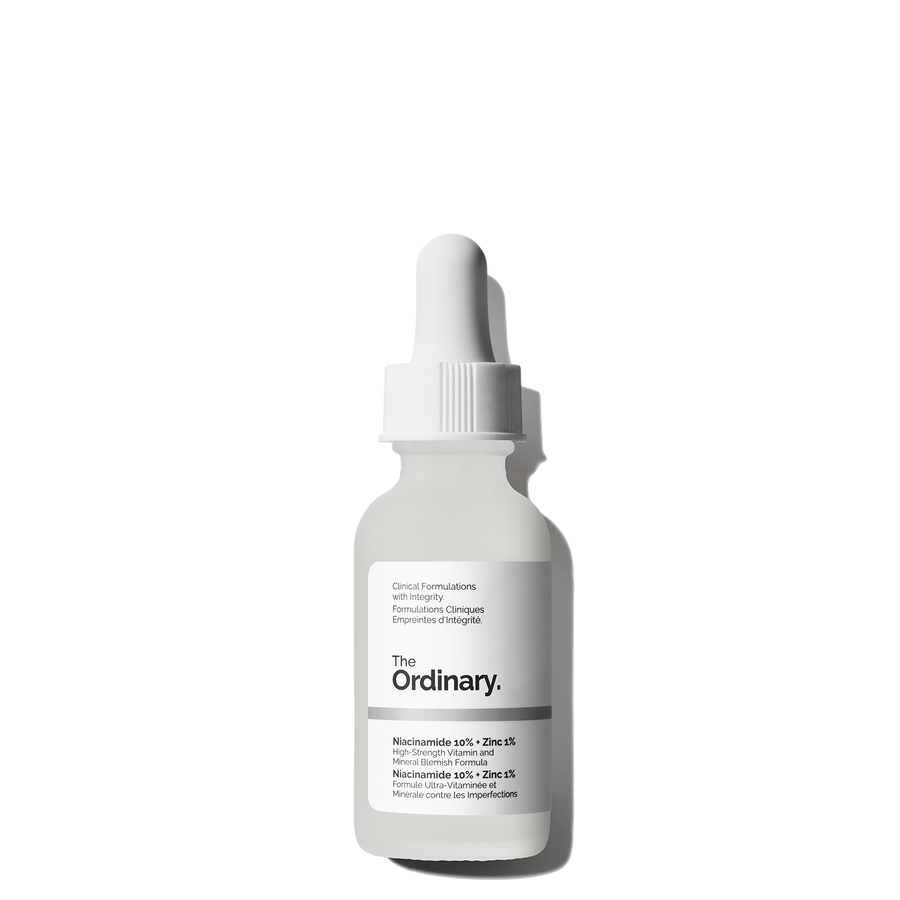
Product
- Brand:
- The Ordinary
- Product type:
- Serums
- Last checked:
- 2026-10-12
- Formula version:
- Pack label · 2026-10-12
- Fragrance & alcohol:
- Fragrance-free · Alcohol-free
11 ingredients on this list · WATER at number 1 · NIACINAMIDE at number 2 · PENTYLENE GLYCOL at number 3
Product description
A water-based serum combining 10% niacinamide with 1% zinc PCA. Marketed for visible blemishes and excess oil. The formula is short and preservative-light.
Brand's own claims
- Helps visibly reduce the look of blemishes (brand claim).
- Balances visible sebum activity (brand claim).
The brand's own claims, quoted from its own material.
Full ingredient list
Kept exactly as the source printed it, including spelling in the original.
- 1 WATER
- 2 NIACINAMIDE
- 3 PENTYLENE GLYCOL
- 4 ZINC PCA
- 5 DIMETHYL ISOSORBIDE
- 6 TAMARINDUS INDICA SEED GUM
- 7 XANTHAN GUM
- 8 ISOCETETH-20
- 9 ETHOXYDIGLYCOL
- 10 PHENOXYETHANOL
- 11 CHLORPHENESIN
Original label text
Aqua (Water), Niacinamide, Pentylene Glycol, Zinc PCA, Dimethyl Isosorbide, Tamarindus Indica Seed Gum, Xanthan Gum, Isoceteth-20, Ethoxydiglycol, Phenoxyethanol, Chlorphenesin.
Ingredient analysis
NIACINAMIDE · Actives · NIACINAMIDE · Barrier lipids · PENTYLENE GLYCOL · Humectants
Barrier lipids
1Lipids that occur naturally in the skin barrier (ceramides, cholesterol, fatty acids).
Humectants
2Bind water and draw it into the upper layers of the skin.
Preservatives
2Inhibit microbial growth so the product stays safe to use.
Solvents
4Dissolve or carry other ingredients.
Evidence
- Skin effect Human trial Certainty: Moderate Primary source
In a randomized, placebo-controlled split-face study of 30 healthy Japanese women, a cosmetic containing 4% niacinamide reduced the skin-surface average roughness (Ra) value significantly more than the niacinamide-free control site after 8 weeks (P<0.05).
Who it applies to: Skin-surface roughness measured by replica profilometry (Ra).
Study limits: Measured at the eye area on a photoaged/wrinkle cohort; the endpoint is surface roughness.
- Skin effect Human trial Certainty: Moderate Primary source
In 20 people with Fitzpatrick skin types IV-V, a broad-spectrum sunscreen containing sclareolide and niacinamide significantly prevented experimentally induced post-inflammatory hyperpigmentation: in stripped, exposed zones the protected skin improved by +5.96 ITA degrees versus -9.88 in unprotected skin (net protection about 16 ITA degrees, p < 0.001).
Who it applies to: People with darker skin phototypes (IV-V) prone to post-inflammatory hyperpigmentation, applying the sunscreen daily for 20 days under UV and visible-light exposure.
Study limits: Small sample (20), within-subject controlled model of experimentally induced pigmentation; the abstract calls for comparative studies with and; industry involvement.
- Skin effect Human trial Certainty: Moderate Primary source
In 72 women with visible signs of ageing, a niacinamide-containing biomimetic lamellar cream significantly improved the Cutometer R5 elasticity parameter, wrinkle score, TEWL and corneometer values over 4 weeks compared against the untreated side.
Who it applies to: Women with visible signs of ageing, applying the cream twice daily for 4 weeks.
Study limits: Grading of high-resolution images failed to detect improvements in skin texture; proof-of-concept studies.
- Skin effect Human trial Certainty: Moderate Primary source
In 91 women with melasma, a skincare routine containing vitamin B3 (niacinamide) and 2-mercaptonicotinyl glycine significantly reduced MASI after 3 months, with roughly 38-41% reduction by 6 months.
Who it applies to: Women aged about 44 with melasma, phototypes III-IV, using the routine twice daily with daily SPF50+ sunscreen.
Study limits: A clinically relevant difference favoured Kligman's triple combination in the first 3 months; industry-funded; skin radiance and fine wrinkles also improved.
- Skin effect Human trial Certainty: Moderate Primary source
In a randomized, double-blind, placebo-controlled split-face trial of 52 Taiwanese subjects, 4% niacinamide alone significantly reduced instrument-measured pore counts at week 8, and 4% niacinamide with 0.03% kinetin produced persistent significant reductions in pore, spot, wrinkle and evenness counts at weeks 8 and 12.
Who it applies to: Instrument-measured facial pore counts over 8-12 weeks.
Study limits: The niacinamide-group showed significant pore reduction at week 8; 'pore counts' is an instrument parameter.
- Skin effect Human trial Certainty: Moderate Primary source
In a double-blind, placebo-controlled trial of 100 Japanese subjects, a 2% niacinamide moisturiser significantly lowered sebum excretion rate after 2 and 4 weeks; in a separate 30-person Caucasian split-face study it significantly reduced casual sebum level after 6 weeks.
Who it applies to: Adults with facial sebum concerns applying a 2% niacinamide moisturiser for 2 to 6 weeks; measured with sebumeter-based sebum excretion rate and casual sebum level.
Study limits: The effect differs by measured endpoint and population.
- Skin effect Human trial Certainty: Moderate Primary source
In 40 people with mild-to-moderate acne all using topical benzoyl peroxide plus adapalene, a moisturiser with ceramides and niacinamide significantly improved non-inflammatory, inflammatory and total acne lesions on that side of the face versus a hydrophilic cream after 8 weeks, and decreased cutaneous irritation.
Who it applies to: People on topical anti-acne medication who add a moisturiser alongside treatment, in a split-face, double-blind, randomized design for 8 weeks.
Study limits: All participants used prescription/OTC anti-acne drugs (5% benzoyl peroxide + 0.1% adapalene). TEWL, hydration, sebum, pH and other biophysical measures stayed close between the two creams. This is adjunctive care.
- Skin effect Human trial Certainty: Moderate Primary source
In a 12-week randomized, double-blind half-face study, a combination of 4-hexylresorcinol and niacinamide improved hyperpigmentation spots (L*), the appearance of fine lines and wrinkles, and skin firmness significantly more than niacinamide alone.
Who it applies to: Chinese adults using the combination cream twice daily for 12 weeks in a split-face design.
Study limits: Industry-funded (Unilever R&D); part of the evidence comes from in-vitro melanocyte and 3D skin models.
- Skin effect Human trial Certainty: Low Primary source
A facial moisturiser containing niacinamide improved stratum corneum barrier function and skin hydration, measured instrumentally, in people with rosacea over four weeks of twice-daily use.
Who it applies to: A leave-on facial moisturiser, applied twice daily for four weeks, in adults with rosacea.
Study limits: The tested article was a finished moisturiser. Fifty participants, one centre, four weeks. The study measured barrier function and hydration.
- Skin effect Human trial Certainty: Low Primary source
In a randomized split-face controlled trial in people with rosacea-associated erythema and sensitive skin, a dermocosmetic containing mineralizing water, probiotic fractions, hyaluronic acid and niacinamide significantly improved erythema at day 15 (p<0.01) and day 30 (p<0.001), with skin erythema, tightness, dryness, hydration and TEWL improving versus the untreated side (p<=0.05).
Who it applies to: Facial erythema, tightness, dryness, hydration and TEWL over 30 days.
Study limits: The comparator is usual skin care / an untreated half-face.
- Skin effect Human trial Certainty: Low Primary source
In an open randomized, vehicle-controlled trial of 48 people with mild-to-moderate facial seborrheic dermatitis, 4% nicotinamide cream once daily for 12 weeks reduced the combined erythema/scaling/infiltration score by 75% from baseline versus 35% with the vehicle (p<0.05).
Who it applies to: Combined clinical score of erythema, scaling and infiltration over 12 weeks.
Study limits: Open-label.
- Skin effect Human trial Certainty: Low Primary source
In 30 women with melasma or post-inflammatory hyperpigmentation, a serum combining lotus sprout extract, tranexamic acid and niacinamide reduced skin tone unevenness by 38% and 33% respectively over 16 weeks (P < 0.008).
Who it applies to: Women with melasma or PIH, 70% with Fitzpatrick skin types IV-VI, applying the serum twice daily for 16 weeks.
Study limits: 30 participants; "skin tone unevenness" is a sponsor-defined endpoint.
- Legal limits Official legal text Certainty: High Primary source
The EU Scientific Committee on Consumer Safety concluded in 2016 that 2-phenoxyethanol is safe as a preservative at a maximum of 1.0%, which is the limit already set in Annex V/29 of the EU Cosmetics Regulation. It estimated a margin of safety of about 50 for children.
Who it applies to: Phenoxyethanol used as a preservative in cosmetic products, at or below 1.0%.
Study limits: The dossier behind the conclusion was submitted by Cosmetics Europe, the industry association, and the committee lowered the default toxicokinetic factor from 4.0 to 1.0 on its way to the 1.0% conclusion. The final opinion kept 1.0%.
Related skin concerns
Skin concerns with evidence for ingredients on this list.
Formula history
1 version of this formula on record.