 PoreWise
Naturium · Serums
Tranexamic Topical Acid 5%
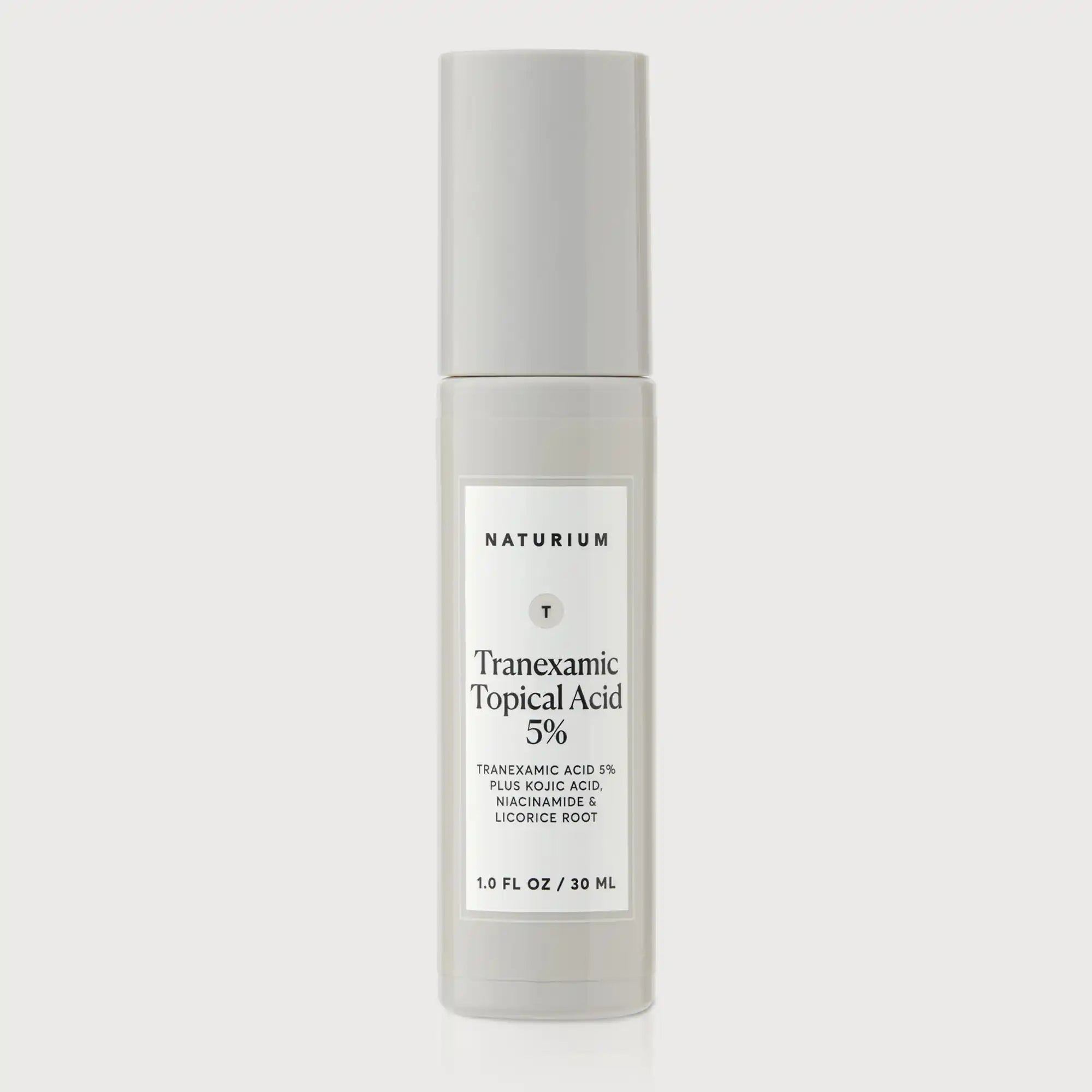
Product
- Brand:
- Naturium
- Product type:
- Serums
- Last checked:
- 2026-10-30
- Formula version:
- Pack label · 2026-10-30
- Fragrance & alcohol:
- Fragrance-free · Alcohol-free
22 ingredients on this list · WATER at number 1 · Isopentyldiol at number 2 · Tranexamic acid at number 3
Product description
A 5% tranexamic acid serum that also lists kojic acid and niacinamide, marketed for dark spots and uneven tone.
Full ingredient list
Kept exactly as the source printed it, including spelling in the original.
- 1 WATER
- 2 ISOPENTYLDIOL
- 3 TRANEXAMIC ACID
- 4 PROPANEDIOL
- 5 CITRIC ACID
- 6 KOJIC ACID
- 7 NIACINAMIDE
- 8 HYDROXYACETOPHENONE
- 9 ISODODECANE
- 10 POLYACRYLATE CROSSPOLYMER-6
- 11 GLYCYRRHIZA GLABRA (LICORICE) ROOT EXTRACT
- 12 PANTHENOL
- 13 GLYCERIN
- 14 XANTHAN GUM
- 15 TREMELLA FUCIFORMIS (MUSHROOM) SPOROCARP EXTRACT
- 16 PHENOXYETHANOL
- 17 ETHYLHEXYLGLYCERIN
- 18 BETAINE
- 19 SODIUM HYALURONATE
- 20 SODIUM PHYTATE
- 21 POTASSIUM SORBATE
- 22 TOCOPHEROL
Original label text
Water, Isopentyldiol, Tranexamic Acid, Propanediol, Citric Acid, Kojic Acid, Niacinamide, Hydroxyacetophenone, Isododecane, Polyacrylate Crosspolymer-6, Glycyrrhiza Glabra (Licorice) Root Extract, Panthenol, Glycerin, Xanthan Gum, Tremella Fuciformis Sporocarp Extract, Phenoxyethanol, Ethylhexylglycerin, Betaine, Sodium Hyaluronate, Sodium Phytate, Potassium Sorbate, Tocopherol
Ingredient analysis
Tranexamic acid · Actives · NIACINAMIDE · Barrier lipids · PROPANEDIOL · Humectants
Actives
4Ingredients added for a stated effect on the skin.
Barrier lipids
1Lipids that occur naturally in the skin barrier (ceramides, cholesterol, fatty acids).
Humectants
7Bind water and draw it into the upper layers of the skin.
Preservatives
2Inhibit microbial growth so the product stays safe to use.
Antioxidants
2Slow oxidation of the formula or of skin surface lipids.
Soothing agents
3Used to reduce the sensation of irritation or discomfort.
Evidence
- Skin effect Human trial Certainty: Moderate Primary source
In a randomized trial of 50 female melasma patients, a topical 5% tranexamic acid cream applied twice daily for 12 weeks reduced the Melasma Area and Severity Index by 50.88% (p=0.001).
Who it applies to: Female melasma patients applying a 5% topical tranexamic acid cream twice daily for 12 weeks (compared with an oral tranexamic acid arm).
Study limits: Small sample (50) and a single-centre study; the trial compared topical against oral tranexamic acid.
- Skin effect Human trial Certainty: Moderate Primary source
In a randomized study of 50 women with melasma, topical 3% tranexamic acid serum plus moisturizer reduced periorbital wrinkle grading significantly more than moisturizer alone at weeks 4, 8 and 12, with the benefit persisting after treatment stopped.
Who it applies to: Women with melasma applying 3% topical tranexamic acid serum plus moisturizer (vs moisturizer alone) for 8 weeks, follow-up to week 12.
Study limits: The population is melasma patients.
- Skin effect Human trial Certainty: Low Primary source
In 30 women with melasma or post-inflammatory hyperpigmentation, a serum combining lotus sprout extract, tranexamic acid and niacinamide reduced skin tone unevenness by 38% and 33% respectively over 16 weeks (P < 0.008).
Who it applies to: Women with melasma or PIH, 70% with Fitzpatrick skin types IV-VI, applying the serum twice daily for 16 weeks.
Study limits: 30 participants; "skin tone unevenness" is a sponsor-defined endpoint.
- Skin effect Human trial Certainty: Moderate Primary source
In a randomized, placebo-controlled split-face study of 30 healthy Japanese women, a cosmetic containing 4% niacinamide reduced the skin-surface average roughness (Ra) value significantly more than the niacinamide-free control site after 8 weeks (P<0.05).
Who it applies to: Skin-surface roughness measured by replica profilometry (Ra).
Study limits: Measured at the eye area on a photoaged/wrinkle cohort; the endpoint is surface roughness.
- Skin effect Human trial Certainty: Moderate Primary source
In 20 people with Fitzpatrick skin types IV-V, a broad-spectrum sunscreen containing sclareolide and niacinamide significantly prevented experimentally induced post-inflammatory hyperpigmentation: in stripped, exposed zones the protected skin improved by +5.96 ITA degrees versus -9.88 in unprotected skin (net protection about 16 ITA degrees, p < 0.001).
Who it applies to: People with darker skin phototypes (IV-V) prone to post-inflammatory hyperpigmentation, applying the sunscreen daily for 20 days under UV and visible-light exposure.
Study limits: Small sample (20), within-subject controlled model of experimentally induced pigmentation; the abstract calls for comparative studies with and; industry involvement.
- Skin effect Human trial Certainty: Moderate Primary source
In 72 women with visible signs of ageing, a niacinamide-containing biomimetic lamellar cream significantly improved the Cutometer R5 elasticity parameter, wrinkle score, TEWL and corneometer values over 4 weeks compared against the untreated side.
Who it applies to: Women with visible signs of ageing, applying the cream twice daily for 4 weeks.
Study limits: Grading of high-resolution images failed to detect improvements in skin texture; proof-of-concept studies.
- Skin effect Human trial Certainty: Moderate Primary source
In 91 women with melasma, a skincare routine containing vitamin B3 (niacinamide) and 2-mercaptonicotinyl glycine significantly reduced MASI after 3 months, with roughly 38-41% reduction by 6 months.
Who it applies to: Women aged about 44 with melasma, phototypes III-IV, using the routine twice daily with daily SPF50+ sunscreen.
Study limits: A clinically relevant difference favoured Kligman's triple combination in the first 3 months; industry-funded; skin radiance and fine wrinkles also improved.
- Skin effect Human trial Certainty: Moderate Primary source
In a randomized, double-blind, placebo-controlled split-face trial of 52 Taiwanese subjects, 4% niacinamide alone significantly reduced instrument-measured pore counts at week 8, and 4% niacinamide with 0.03% kinetin produced persistent significant reductions in pore, spot, wrinkle and evenness counts at weeks 8 and 12.
Who it applies to: Instrument-measured facial pore counts over 8-12 weeks.
Study limits: The niacinamide-group showed significant pore reduction at week 8; 'pore counts' is an instrument parameter.
- Skin effect Human trial Certainty: Moderate Primary source
In a double-blind, placebo-controlled trial of 100 Japanese subjects, a 2% niacinamide moisturiser significantly lowered sebum excretion rate after 2 and 4 weeks; in a separate 30-person Caucasian split-face study it significantly reduced casual sebum level after 6 weeks.
Who it applies to: Adults with facial sebum concerns applying a 2% niacinamide moisturiser for 2 to 6 weeks; measured with sebumeter-based sebum excretion rate and casual sebum level.
Study limits: The effect differs by measured endpoint and population.
- Skin effect Human trial Certainty: Moderate Primary source
In 40 people with mild-to-moderate acne all using topical benzoyl peroxide plus adapalene, a moisturiser with ceramides and niacinamide significantly improved non-inflammatory, inflammatory and total acne lesions on that side of the face versus a hydrophilic cream after 8 weeks, and decreased cutaneous irritation.
Who it applies to: People on topical anti-acne medication who add a moisturiser alongside treatment, in a split-face, double-blind, randomized design for 8 weeks.
Study limits: All participants used prescription/OTC anti-acne drugs (5% benzoyl peroxide + 0.1% adapalene). TEWL, hydration, sebum, pH and other biophysical measures stayed close between the two creams. This is adjunctive care.
- Skin effect Human trial Certainty: Moderate Primary source
In a 12-week randomized, double-blind half-face study, a combination of 4-hexylresorcinol and niacinamide improved hyperpigmentation spots (L*), the appearance of fine lines and wrinkles, and skin firmness significantly more than niacinamide alone.
Who it applies to: Chinese adults using the combination cream twice daily for 12 weeks in a split-face design.
Study limits: Industry-funded (Unilever R&D); part of the evidence comes from in-vitro melanocyte and 3D skin models.
- Skin effect Human trial Certainty: Low Primary source
A facial moisturiser containing niacinamide improved stratum corneum barrier function and skin hydration, measured instrumentally, in people with rosacea over four weeks of twice-daily use.
Who it applies to: A leave-on facial moisturiser, applied twice daily for four weeks, in adults with rosacea.
Study limits: The tested article was a finished moisturiser. Fifty participants, one centre, four weeks. The study measured barrier function and hydration.
- Skin effect Human trial Certainty: Low Primary source
In a randomized split-face controlled trial in people with rosacea-associated erythema and sensitive skin, a dermocosmetic containing mineralizing water, probiotic fractions, hyaluronic acid and niacinamide significantly improved erythema at day 15 (p<0.01) and day 30 (p<0.001), with skin erythema, tightness, dryness, hydration and TEWL improving versus the untreated side (p<=0.05).
Who it applies to: Facial erythema, tightness, dryness, hydration and TEWL over 30 days.
Study limits: The comparator is usual skin care / an untreated half-face.
- Skin effect Human trial Certainty: Low Primary source
In an open randomized, vehicle-controlled trial of 48 people with mild-to-moderate facial seborrheic dermatitis, 4% nicotinamide cream once daily for 12 weeks reduced the combined erythema/scaling/infiltration score by 75% from baseline versus 35% with the vehicle (p<0.05).
Who it applies to: Combined clinical score of erythema, scaling and infiltration over 12 weeks.
Study limits: Open-label.
- Skin effect Human trial Certainty: Moderate Primary source
In 88 women with sensitive skin, a face cream containing Centella asiatica leaf extract, ceramide NP and panthenol lowered the SS-10 symptom score by 66% at week 2 and 76% at week 4, with irritation, tautness, itching and redness all significantly reduced.
Who it applies to: Chinese women with sensitive skin applying the cream to the whole face, followed up at day 2, weeks 1, 2 and 4.
Study limits: Observational and self-controlled.
- Skin effect Human trial Certainty: Moderate Primary source
In 38 children with atopic dermatitis, a cream containing linoleic acid, 5% dexpanthenol and ceramide improved SCORAD significantly more than a 5% urea cream after 4 weeks (P = 0.043); both groups improved from baseline.
Who it applies to: Children with mild-to-moderate atopic dermatitis applying the cream twice daily for 4 weeks in a randomised, double-blind, bilateral paired design.
Study limits: Both interventions were non-prescription moisturisers: this is emollient / basic skin care. Small sample (37 completed); stratum corneum hydration and time to remission stayed close between groups.
- Skin effect Human trial Certainty: Moderate Primary source
In 110 people with facial sensitive skin, a cream containing panthenol used twice daily for 28 days significantly increased stratum corneum moisture and reduced erythema index, redness (a* value) and transepidermal water loss.
Who it applies to: People with facial sensitive skin applying the cream twice daily for 28 days.
Study limits: Panthenol was combined with prebiotics and a probiotic lysate.
- Skin effect Human trial Certainty: Low Primary source
After facial non-ablative fractional laser treatment, a panthenol mask lowered the erythema and pigmentation indices on days 3, 7 and 14 against a saline dressing, raised stratum corneum moisture, and reduced transepidermal water loss over the same days. Sebum content was also higher in the mask group on days 7 and 14.
Who it applies to: Skin recovering from 1550 nm and 1927 nm non-ablative fractional laser on the face. Both groups received standard post-procedure care.
Study limits: The mask also contained madecassoside and bisabolol. It is one trial of 60 people, all recovering from the same procedure, and the published grant list includes L'Oreal Dermatological Beauty China (La Roche-Posay).
- Skin effect Human trial Certainty: Low Primary source
In a randomized, investigator-blind, split-face trial of 40 Asian acne patients, a moisturizer containing 4-t-butylcyclohexanol, licochalcone A, ceramide and panthenol improved facial hydration more than a traditional moisturizer (p=0.001) and produced lower dryness scores (p=0.021) over 4 weeks.
Who it applies to: Facial hydration and investigator-rated dryness over 4 weeks.
Study limits: All participants were on prescription acne therapy (including oral isotretinoin), so the dryness is drug-induced; both sides used a moisturizer, so this is a comparison between two moisturisers; acne lesion counts decreased equally on both sides.
- Sensitization Review article Certainty: Low Primary source
Panthenol is treated as non-allergenic, this review argues that frequent exposure, especially on damaged skin, can produce hypersensitivity to it. The likely route is a delayed (type IV) contact reaction; immediate and mixed reactions remain possible. Proposes patch testing with the patient's own product and with panthenol 5% in petrolatum.
Who it applies to: People who use panthenol products repeatedly, particularly those with atopic or damaged skin - the group the author says is most exposed.
Study limits: A single-author narrative review. The mechanism it proposes is stated as likely. Read it as a reason to keep panthenol on the list of possible allergens.
- Skin effect Human trial Certainty: Moderate Primary source
In a randomized, double-blind, four-arm crossover study of 51 healthy volunteers with dry skin, an emollient containing glycerol and petrolatum raised corneometry-measured skin moisture significantly above its vehicle (P < 0.0001) over 12 hours. The authors attributed the hydration gain to the glycerol component and the lower water loss to the petrolatum component.
Who it applies to: Corneometry (skin moisture) and transepidermal water loss over 12 hours after one application.
Study limits: Measured on the forearms. The significant hydration result comes from the full emollient containing both glycerol and petrolatum.
- Skin effect Review article Certainty: Moderate Primary source
Topical glycerol improves stratum corneum hydration, barrier function and skin mechanical properties. The review also reports reduced irritation response and faster wound healing, and traces the effect to aquaporin-3 transport and to glycerol's own presence in the skin.
Who it applies to: Leave-on products. The review discusses both healthy skin and skin with dry or barrier-impaired conditions such as atopic dermatitis.
Study limits: A narrative review. It compiles mechanisms and results from other studies.
- Skin effect Official ingredient listing Certainty: High Public database
Glycerin is classified as a humectant in cosmetic ingredient databases: its role in a formula is to hold water.
Who it applies to: Cosmetic formulas generally. · Ingredient database · GLYCERIN
Study limits: Skin effect of to the stratum corneum comes from a separate review of the literature. · Ingredient database · GLYCERIN
- Skin effect Human trial Certainty: Moderate Primary source
All five 0.1% hyaluronic acid creams tested, from 50 kDa to 2000 kDa, raised skin hydration and overall elasticity above the vehicle cream applied to the other eye at 60 days.
Who it applies to: 0.1% hyaluronic acid creams applied twice daily for 60 days to the eye area of women aged 30-60 with periocular wrinkles.
Study limits: Sixty days, and the vehicle sat on the fellow eye. Hydration and elasticity were read by instruments. The volunteers were women aged 30-60 with eye-area wrinkles.
- How deep it gets In vitro study Certainty: Moderate Primary source
Hyaluronic acid of 20-300 kDa crossed the stratum corneum in excised human skin, while hyaluronic acid of 1000-1400 kDa remained in the stratum corneum.
Who it applies to: Excised human skin with intact stratum corneum, measured by Raman micro-imaging after topical application.
Study limits: One laboratory's imaging study. Three molecular-weight grades were tested. "remains above" describes intact stratum corneum in this ex vivo setup.
- Skin effect Brand claim Certainty: Moderate Public database
Hyaluronic acid and its salt bind water at the skin surface, giving a plumper look immediately after application.
Who it applies to: Leave-on hydrating products.
Study limits: The effect is largely surface and temporary. In dry air a humectant. · Finding · Sodium hyaluronate · Hydrolyzed hyaluronic acid
- Legal limits Official legal text Certainty: High Primary source
The EU Scientific Committee on Consumer Safety concluded in 2016 that 2-phenoxyethanol is safe as a preservative at a maximum of 1.0%, which is the limit already set in Annex V/29 of the EU Cosmetics Regulation. It estimated a margin of safety of about 50 for children.
Who it applies to: Phenoxyethanol used as a preservative in cosmetic products, at or below 1.0%.
Study limits: The dossier behind the conclusion was submitted by Cosmetics Europe, the industry association, and the committee lowered the default toxicokinetic factor from 4.0 to 1.0 on its way to the 1.0% conclusion. The final opinion kept 1.0%.
- Skin effect Human trial Certainty: Moderate Primary source
In a split-face randomized controlled trial of 50 women, a serum with 20% vitamin C, vitamin E and raspberry leaf cell culture extract significantly improved skin radiance measured by Glossymeter GL200, along with skin colour and elasticity, over 2 months.
Who it applies to: Women aged 30-65 applying the serum to one side of the face for 2 months, with the untreated side as control.
Study limits: Split-face with an untreated.
- Skin effect Human trial Certainty: Low Primary source
In 31 women aged 43-65, a serum combining vitamins C and E with green tea polyphenols produced statistically significant improvements in all clinically graded parameters over 12 weeks, including enhanced skin smoothness and radiance, plus an ultrasound-measured increase in skin density.
Who it applies to: Women aged 43-65 with photoaged facial skin, applying the serum twice daily for 12 weeks.
Study limits: Radiance was a clinical grading parameter.
- Skin effect Human trial Certainty: Low Primary source
In a double-blind trial that split each scar into two halves. Or made worse, the cosmetic appearance.
Who it applies to: Scars after surgical removal of skin cancer, treated twice daily for four weeks with a petrolatum-based ointment.
Study limits: Fifteen people, one centre, published in 1999. Pigmentation, or the job vitamin E does inside a formula, where it slows oxidation of the oils.
- Sensitization Human trial Certainty: Low Primary source
In the same split-scar trial, 33% of the participants developed contact dermatitis to the vitamin E ointment.
Who it applies to: Vitamin E in a petrolatum-based ointment applied to healing surgical wounds, twice daily for four weeks.
Study limits: Small trial (15 people) with a single product.
Related skin concerns
Skin concerns with evidence for ingredients on this list.
Formula history
1 version of this formula on record.