 PoreWise
Paula's Choice · Serums
C15 Brightening Super Booster
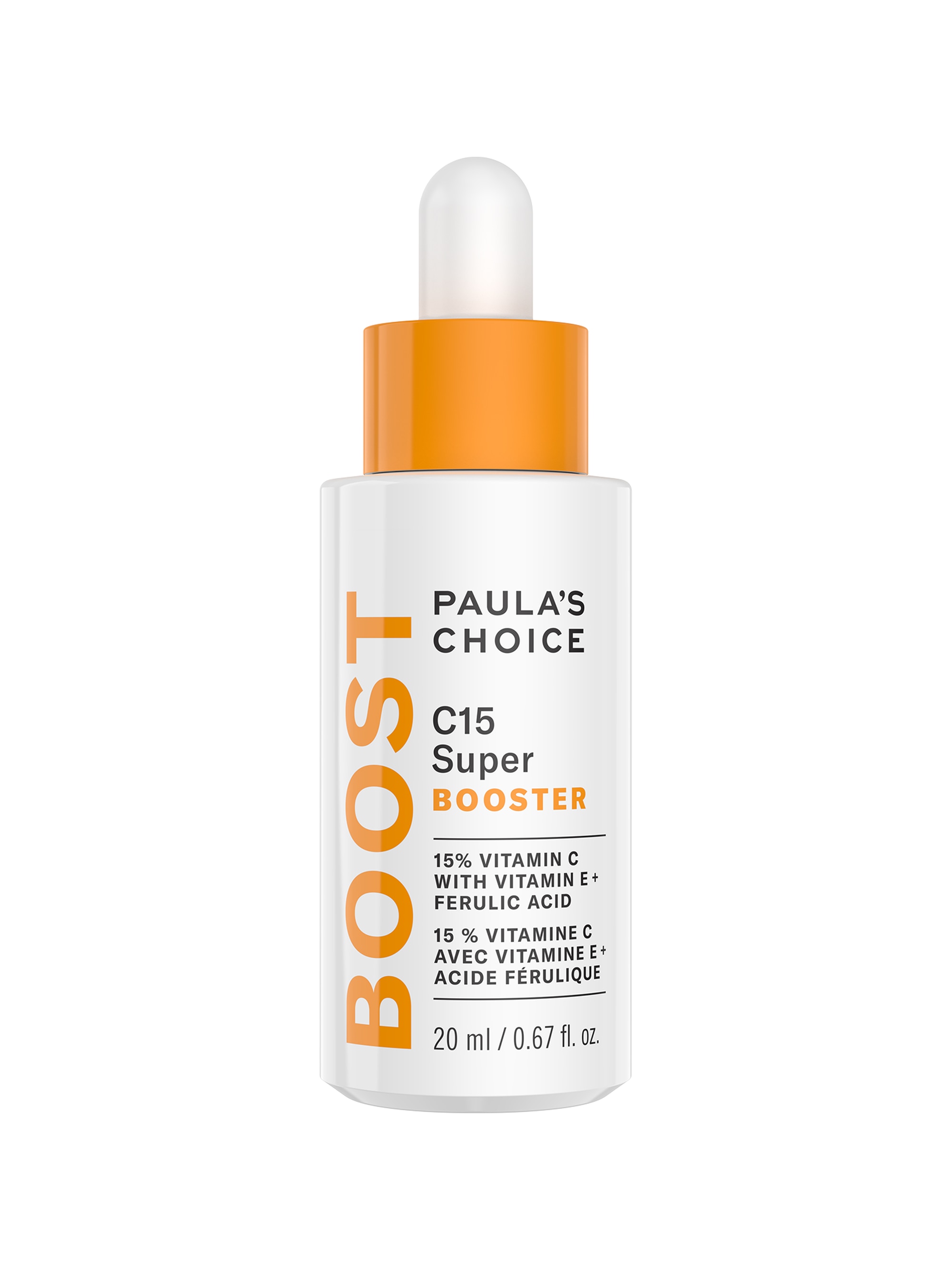
Product
- Brand:
- Paula's Choice
- Product type:
- Serums
- Last checked:
- 2026-10-30
- Formula version:
- Pack label · 2026-10-30
- Fragrance & alcohol:
- Fragrance-free · Alcohol-free
17 ingredients on this list · WATER at number 1 · Vitamin C (L-ascorbic acid) at number 2 · Dipropylene glycol at number 3
Product description
A serum with 15% vitamin C as ascorbic acid, alongside ferulic acid and vitamin E. The brand markets it for dark spots, dullness and fine lines.
Brand's own claims
- Visibly brightens, smooths and firms; addresses dark spots and dullness (brand claim).
The brand's own claims, quoted from its own material.
Full ingredient list
Kept exactly as the source printed it, including spelling in the original.
- 1 WATER
- 2 ASCORBIC ACID
- 3 DIPROPYLENE GLYCOL
- 4 PROPANEDIOL
- 5 GLYCERIN
- 6 ETHOXYDIGLYCOL
- 7 SODIUM HYDROXIDE
- 8 PPG-26-BUTETH-26
- 9 PEG-40 HYDROGENATED CASTOR OIL
- 10 BISABOLOL
- 11 FERULIC ACID
- 12 SODIUM PHYTATE
- 13 DECYLENE GLYCOL
- 14 TOCOPHEROL
- 15 1,2-HEXANEDIOL
- 16 SPHINGOMONAS FERMENT EXTRACT
- 17 PHENOXYETHANOL
Original label text
Aqua/Water/Eau, Ascorbic Acid, Dipropylene Glycol, Propanediol, Glycerin, Ethoxydiglycol, Sodium Hydroxide, PPG-26-Buteth-26, PEG-40 Hydrogenated Castor Oil, Bisabolol, Ferulic Acid, Sodium Phytate, Decylene Glycol, Tocopherol, 1,2-Hexanediol, Sphingomonas Ferment Extract, Phenoxyethanol.
Ingredient analysis
Vitamin C (L-ascorbic acid) · Actives · PROPANEDIOL · Humectants · PPG-26-Buteth-26 · Cleansing agents
Humectants
3Bind water and draw it into the upper layers of the skin.
Preservatives
2Inhibit microbial growth so the product stays safe to use.
Antioxidants
3Slow oxidation of the formula or of skin surface lipids.
Solvents
5Dissolve or carry other ingredients.
Other
3Use on the ingredient list: see the product ingredient list.
Evidence
- Skin effect Human trial Certainty: Moderate Primary source
In a double-blind, vehicle-controlled trial of 30 people with two or more solar lentigines, a serum with 10% L-ascorbic acid and 2% phytic acid lowered the pigmentation index of the treated lesions over three months while the vehicle-treated lesions stayed stable (P <= 0.003 from month 1 to month 4). Six adverse events, mostly halo depigmentation, were judged possibly related to the product.
Who it applies to: Pigmentation index, dermoscopic pigmentation and brightness (L*) of solar lentigines over three months, with two months of follow-up.
Study limits: The serum combines two actives. Each person applied the product to one side of the body and the vehicle to the other. 30 people, and six halo-depigmentation events were possibly related to the product. The authors call for larger studies.
- Skin effect Human trial Certainty: Moderate Primary source
In a split-face randomized controlled trial of 50 women, a serum with 20% vitamin C, vitamin E and raspberry leaf cell culture extract significantly improved skin radiance measured by Glossymeter GL200, along with skin colour and elasticity, over 2 months.
Who it applies to: Women aged 30-65 applying the serum to one side of the face for 2 months, with the untreated side as control.
Study limits: Split-face with an untreated.
- Skin effect Human trial Certainty: Moderate Primary source
In a 3-month randomized, double-blind, vehicle-controlled trial of 19 volunteers with photodamaged skin, topical ascorbic acid produced a 73.7% greater improvement in optical profilometry Ra and shadows values than the vehicle, with significant clinical improvement in tactile roughness.
Who it applies to: Adults aged 36-72 with mild-to-moderate facial photodamage, applying the serum daily for 3 months.
Study limits: Small sample (19) in photodamaged.
- Skin effect Human trial Certainty: Moderate Primary source
In a 12-week hemi-member, randomized, double-blind, comparative study of 18 patients over 60 with Bateman purpura, twice-daily 5% topical vitamin C improved skin symptoms and increased dermal thickness and elasticity on the treated side versus control.
Who it applies to: Adults over 60 with Bateman purpura (senile purpura) applying 5% topical vitamin C twice daily for 12 weeks.
Study limits: Small sample (18 patients) and a single-centre study; the population is photodamaged older skin.
- Skin effect Human trial Certainty: Low Primary source
In a randomized, double-blind, placebo-controlled split-face trial, 24 people with mixed-type dark circles used a test product containing 3% vitamin C, 0.1% vitamin A and 0.5% vitamin E for eight weeks. Brightness (L*), melanin index and image-analysis lightness improved significantly on the treated side compared with the placebo side.
Who it applies to: Instrument-measured brightness, melanin index and skin thickness in mixed-type (pigment plus vascular) dark circles over eight weeks.
Study limits: Three actives were used together. 24 people took part, all with the mixed type of dark circles; a separate 100-person study was used first to choose which measurements to trust. The abstract reports instrument readings.
- Skin effect Human trial Certainty: Low Primary source
In 31 women aged 43-65, a serum combining vitamins C and E with green tea polyphenols produced statistically significant improvements in all clinically graded parameters over 12 weeks, including enhanced skin smoothness and radiance, plus an ultrasound-measured increase in skin density.
Who it applies to: Women aged 43-65 with photoaged facial skin, applying the serum twice daily for 12 weeks.
Study limits: Radiance was a clinical grading parameter.
- Skin effect Review article Certainty: Low Primary source
A 2023 systematic review of 7 randomized controlled trials (139 volunteers) found that topically applied vitamin C made uneven, wrinkled skin appear smoother and lightened pigmentation on objective assessments, though noticeable change may need long-term use.
Who it applies to: Topical vitamin C formulations studied for melasma or photodamage.
Study limits: The included trials were small; the review notes more studies are needed on the ideal concentration and long-term effect.
- Skin effect Human trial Certainty: Moderate Primary source
In a randomized, double-blind, four-arm crossover study of 51 healthy volunteers with dry skin, an emollient containing glycerol and petrolatum raised corneometry-measured skin moisture significantly above its vehicle (P < 0.0001) over 12 hours. The authors attributed the hydration gain to the glycerol component and the lower water loss to the petrolatum component.
Who it applies to: Corneometry (skin moisture) and transepidermal water loss over 12 hours after one application.
Study limits: Measured on the forearms. The significant hydration result comes from the full emollient containing both glycerol and petrolatum.
- Skin effect Review article Certainty: Moderate Primary source
Topical glycerol improves stratum corneum hydration, barrier function and skin mechanical properties. The review also reports reduced irritation response and faster wound healing, and traces the effect to aquaporin-3 transport and to glycerol's own presence in the skin.
Who it applies to: Leave-on products. The review discusses both healthy skin and skin with dry or barrier-impaired conditions such as atopic dermatitis.
Study limits: A narrative review. It compiles mechanisms and results from other studies.
- Skin effect Official ingredient listing Certainty: High Public database
Glycerin is classified as a humectant in cosmetic ingredient databases: its role in a formula is to hold water.
Who it applies to: Cosmetic formulas generally. · Ingredient database · GLYCERIN
Study limits: Skin effect of to the stratum corneum comes from a separate review of the literature. · Ingredient database · GLYCERIN
- Legal limits Official legal text Certainty: High Primary source
The EU Scientific Committee on Consumer Safety concluded in 2016 that 2-phenoxyethanol is safe as a preservative at a maximum of 1.0%, which is the limit already set in Annex V/29 of the EU Cosmetics Regulation. It estimated a margin of safety of about 50 for children.
Who it applies to: Phenoxyethanol used as a preservative in cosmetic products, at or below 1.0%.
Study limits: The dossier behind the conclusion was submitted by Cosmetics Europe, the industry association, and the committee lowered the default toxicokinetic factor from 4.0 to 1.0 on its way to the 1.0% conclusion. The final opinion kept 1.0%.
- Skin effect Human trial Certainty: Low Primary source
In a double-blind trial that split each scar into two halves. Or made worse, the cosmetic appearance.
Who it applies to: Scars after surgical removal of skin cancer, treated twice daily for four weeks with a petrolatum-based ointment.
Study limits: Fifteen people, one centre, published in 1999. Pigmentation, or the job vitamin E does inside a formula, where it slows oxidation of the oils.
- Sensitization Human trial Certainty: Low Primary source
In the same split-scar trial, 33% of the participants developed contact dermatitis to the vitamin E ointment.
Who it applies to: Vitamin E in a petrolatum-based ointment applied to healing surgical wounds, twice daily for four weeks.
Study limits: Small trial (15 people) with a single product.
Related skin concerns
Skin concerns with evidence for ingredients on this list.
Formula history
1 version of this formula on record.